Johann Springorum der Ältere

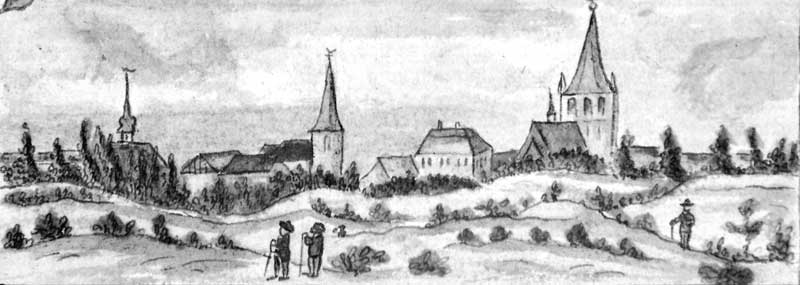
Johann Springorum (der Ältere), geboren rond 1420 als zoon van Dietrich Springorum, groeide uit tot een vooraanstaand burger van het vijftiende-eeuwse Bochum en behoort tot de vroegst met zekerheid gedocumenteerde leden van de familie Springorum. Hij verschijnt voor het eerst in de bronnen in 1441 en bekleedde het ambt van burgemeester van Bochum tussen 1476 en 1482. Daarnaast wordt hij herhaaldelijk genoemd als getuige in juridische en bestuurlijke oorkonden, waarmee hij duidelijk tot de gevestigde stedelijke elite behoorde.
Zijn invloed reikte tot in de volgende generatie via zijn dochter Nese (Agnes) Springorum, die trouwde met Johann Schriver, Richter zu Essen. Door dit huwelijk werd de naam Springorum doorgegeven aan Johann Schriver, die vervolgens wordt vermeld als Johann Schriver genannt Springorum. Zo werd de familienaam via de vrouwelijke lijn voortgezet in latere generaties.
Events & References
Monetary Rent Sale
14 February 1441 · Bochum, Deutschland
On 14 February 1441, Dietrich Springorum sold a yearly rent of half a mark from his house and farm in Bochum, located behind the Bungener house, to Karden von Beckum. The sale was made with the explicit consent of his wife Karden and his sons Baten and Johann, as required to protect family and inheritance rights, and was formally confirmed before the Bochum magistrate Wennemar Paskendal and other witnesses. This document is particularly important because it is the earliest record in which Dietrich appears and, at the same time, clearly identifies his wife and children, making it a key source for understanding the earliest documented family relationships within the Springorum lineage.
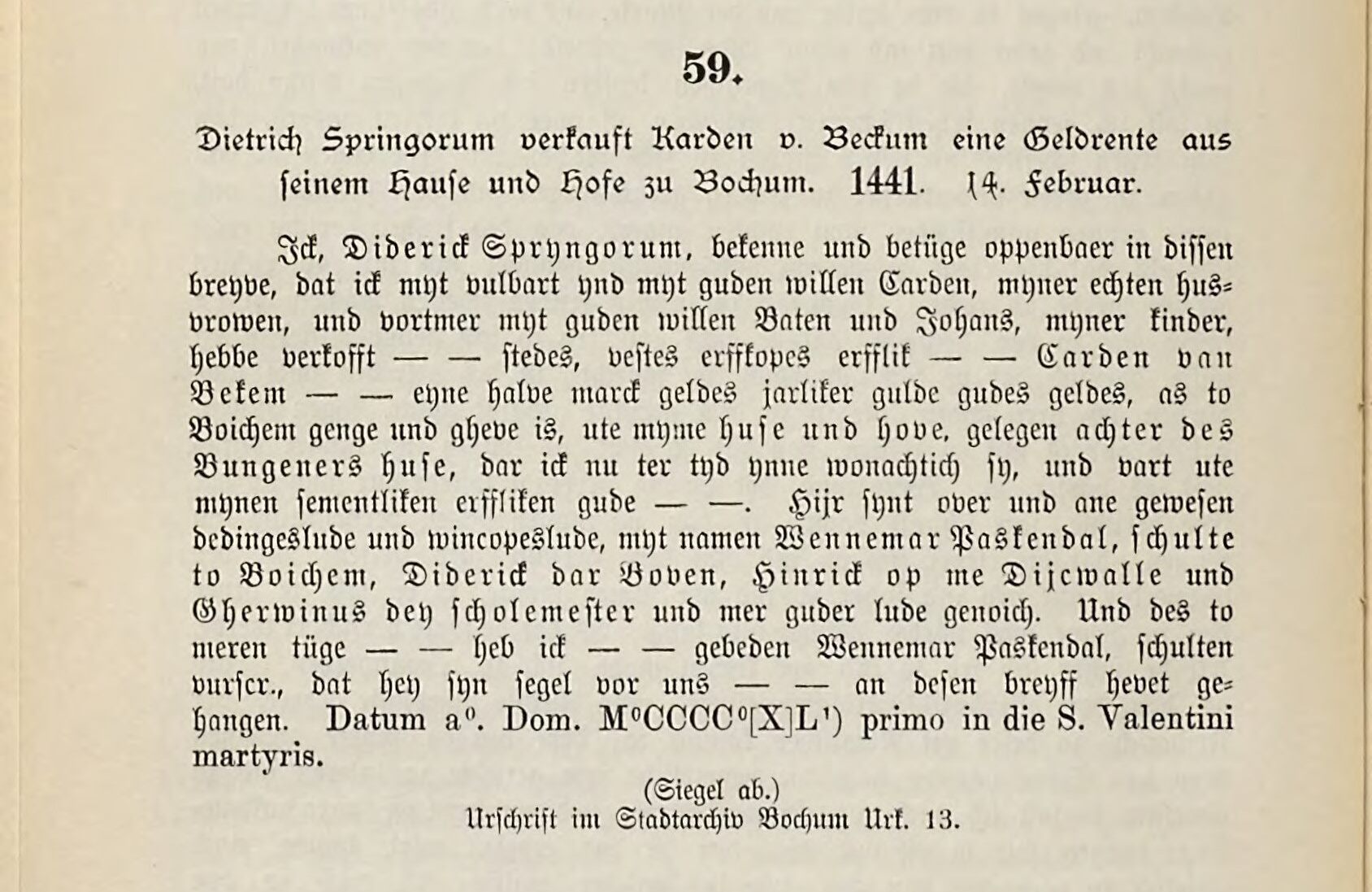
Reference: Monetary Rent Sale
Charter of Sale of a Hereditary Annual Rent
12 June 1473 · Essen and Bochum, Deutschland
In June 1473, Bernt van Dungelen and his wife Else sold a hereditary annual rent of four and one half guilders, secured on their mill, meadows, and other landed property in the jurisdictions of Essen and Bochum. The rent was acquired by Elisabeth van Brunkhorst, Johanne van Herbruggen, and Dideriche van Twyngenborch, acting as lawful representatives of the late Engelbert Mocken, and was payable annually on St. Martin’s Day. Because part of the pledged property lay within the jurisdiction of Bochum, the transaction was confirmed and sealed before the courts of both Essen and Bochum, with judges from each court affixing their seals.
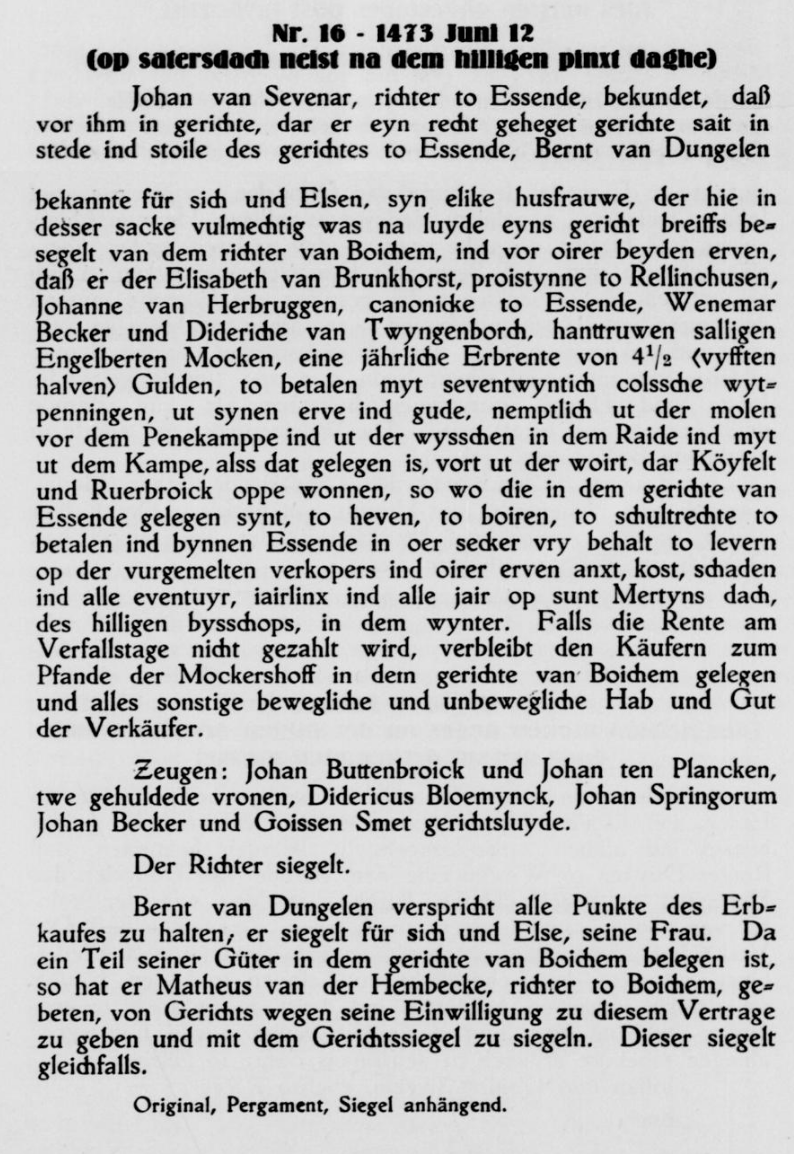
Reference: Charter of Sale of a Hereditary Annual Rent
Sale of Grain Rent
13 May 1475 · Bochum, Deutschland
In 1475, Rutger Roeffhake and his wife Yde sold an annual grain rent to the church of Bochum, secured on their house, farmstead, and all associated hereditary property within the town. The rent consisted of one malder of good, clean grain, half rye and half barley, to be delivered yearly as a perpetual memorial foundation. The charter lists several witnesses, including Johann Springorum, and was sealed by Rutger Roeffhake himself.
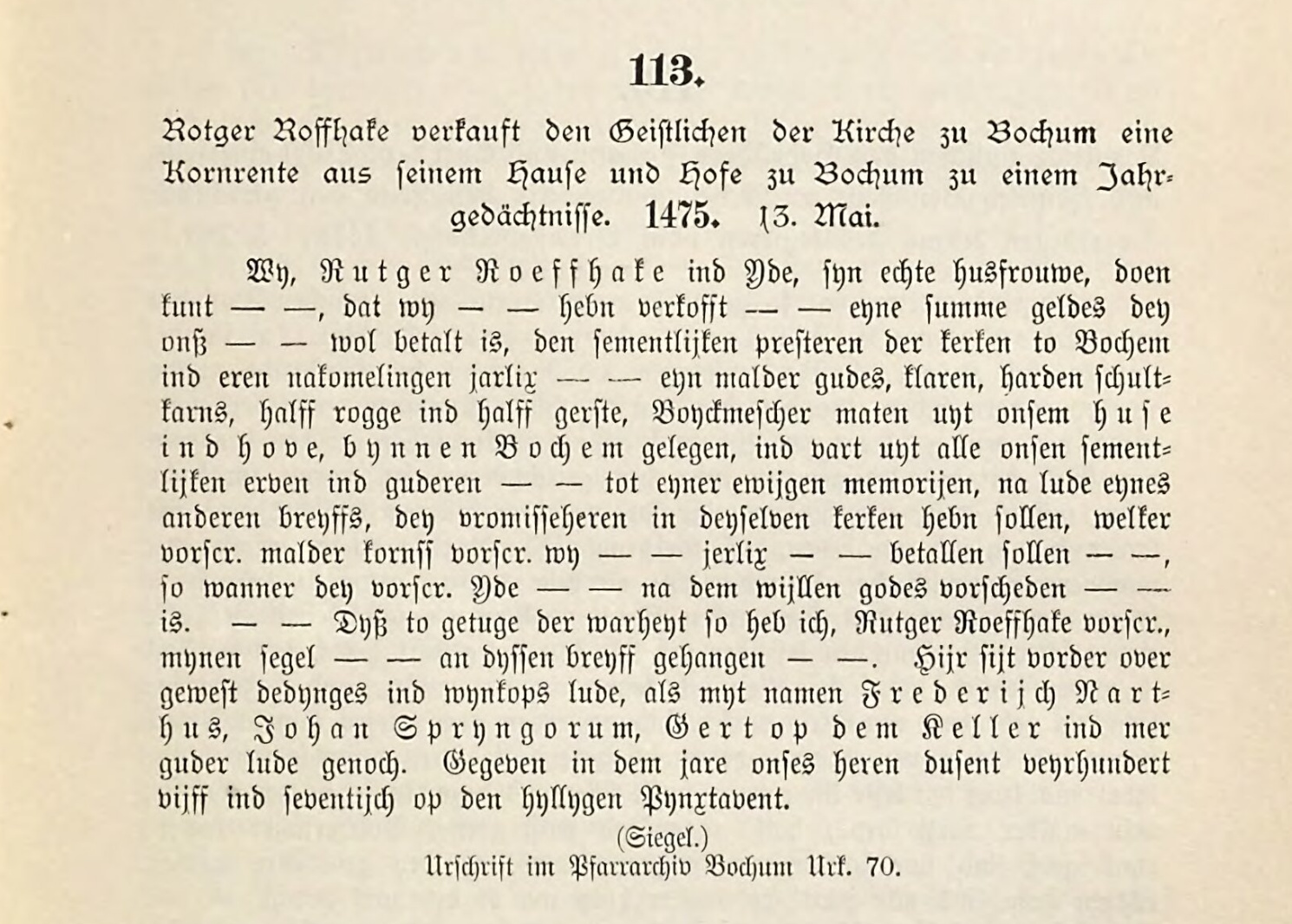
Reference: Sale of Grain Rent
Johann Springorum, Bürgermeister of Bochum
1476 · Bochum, Deutschland
This nineteenth-century historical study by Franz Darpe records the sequence of mayors of medieval Bochum on the basis of municipal charters and parish sources. Within this official listing, Johann Springorum is identified as serving as Bürgermeister of Bochum between 1476 and 1482, together with Albert Scholemester. His appearance among the town’s chief magistrates provides clear evidence of his position within the urban governing elite and marks an important moment in the rise of the Springorum family in late medieval Bochum.
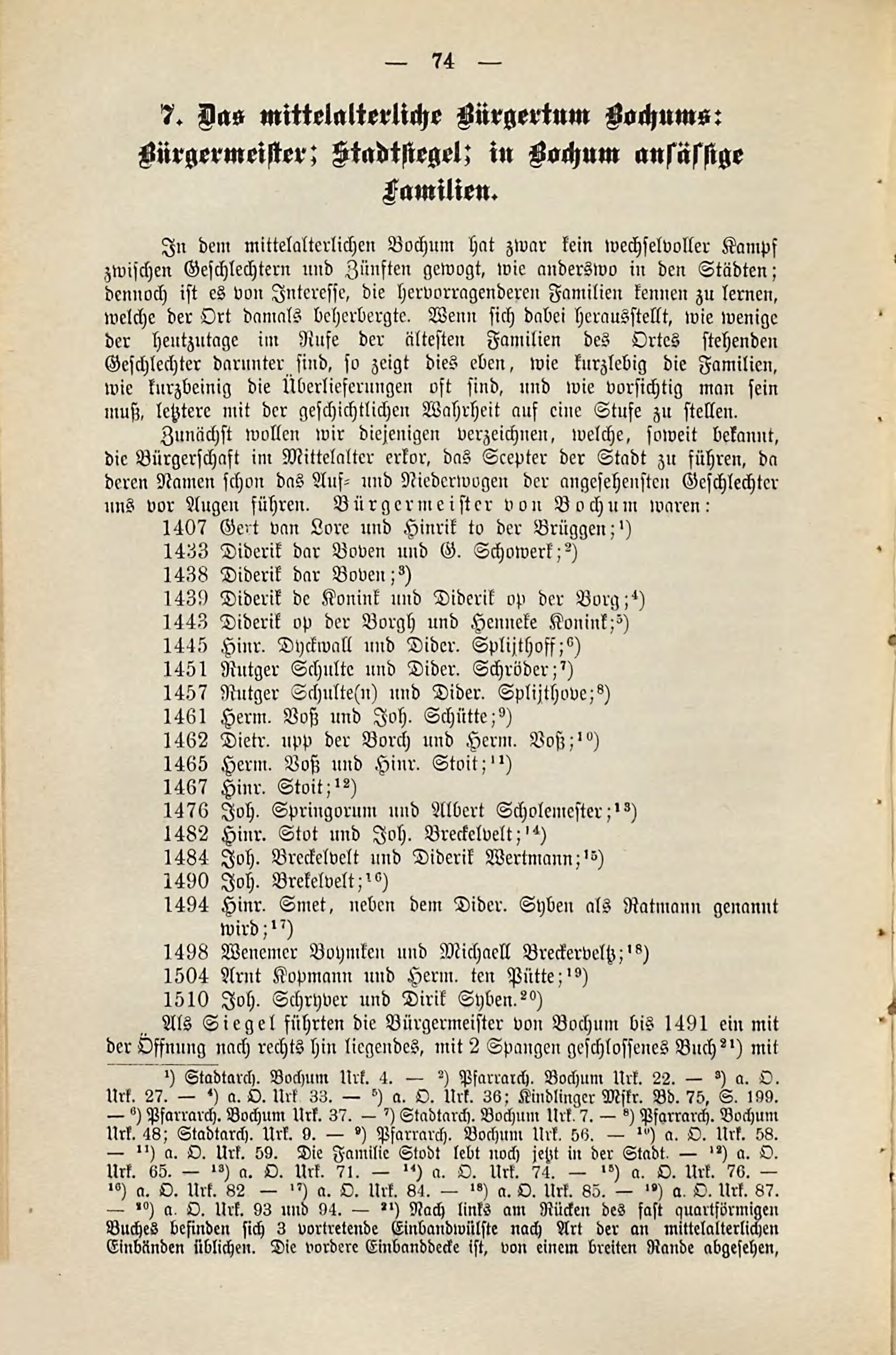
Reference: Johann Springorum, Bürgermeister of Bochum
Pledge of Kamp Tocke
26 October 1478 · Bochum, Deutschland
On 26 October 1478, Johann von Galen, son of Johann, pledged the field known as Kamp Tocke to Wennemar Paschendael, bailiff (Schultheiß) of Bochum. The pledge was made for the sum of seventeen Upper Rhenish gold guilders, with the condition that Johann von Galen retained the right to redeem the property later.
This charter bears the earliest known Springorum seal.
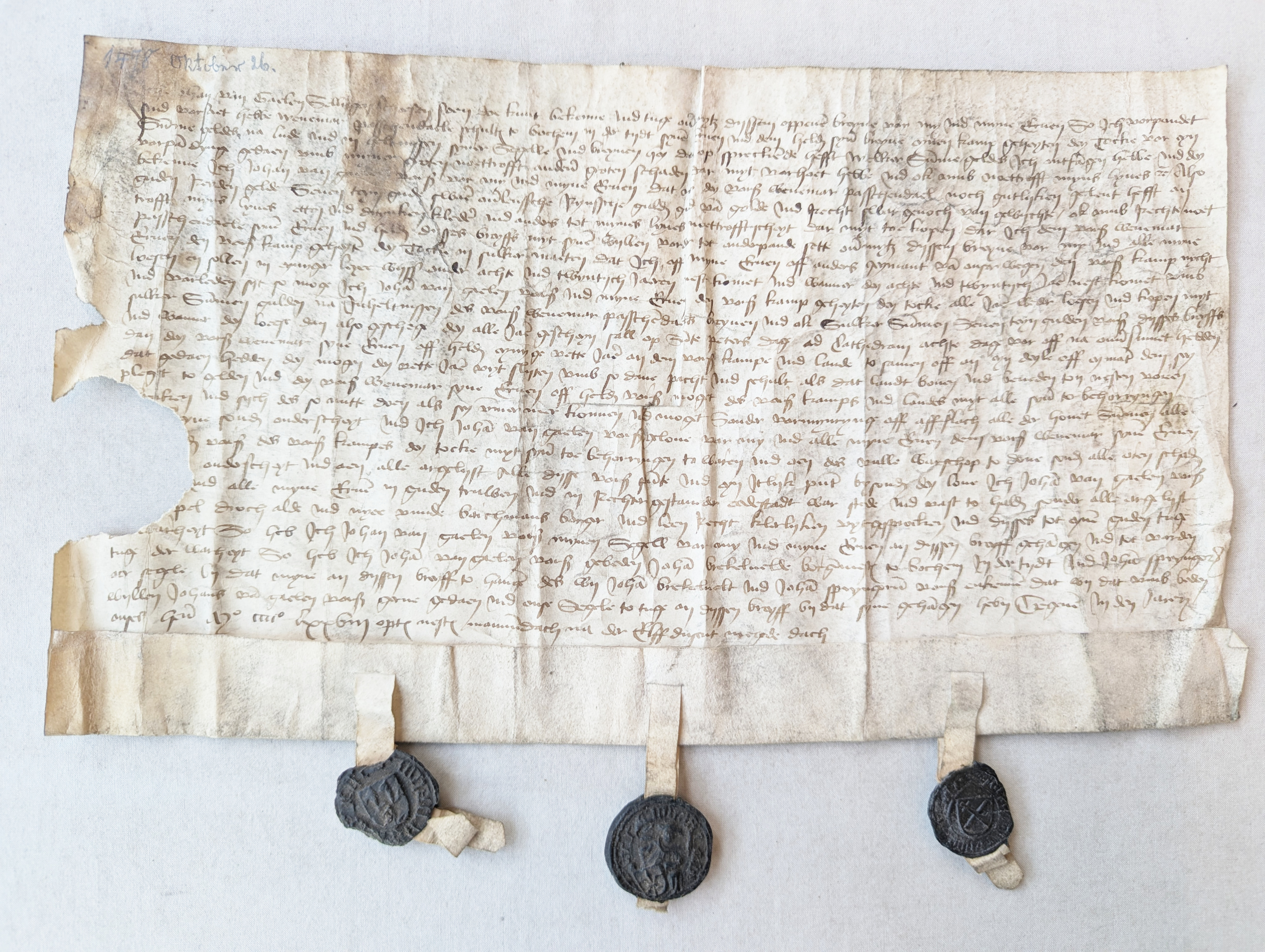
Reference: Pledge of Kamp Tocke
Settlement on the Eviction from the Brunsteinshof at Rechen
7 December 1478 · Bochum / Rechen
On 7 December 1478 the brothers Johann and Everd von Eickel reached an amicable settlement with Heinrich Brunstein of Rechen and his wife Gerdrut concerning Brunstein’s court-ordered removal from the Brunsteinshof. Brunstein and his wife agreed to vacate the estate within a fixed term, while certain parcels were temporarily retained by Hermann Dunneherne. In compensation, the brothers von Eickel committed themselves and their heirs to provide Heinrich and Gerdrut annually for their lifetimes with grain, livestock, wood, and other goods, to be delivered each year on St. Martin’s Day. The agreement was concluded in the presence of numerous witnesses, including Johann Springorum, and sealed by Wenemar Hasenkamp, drost of Bochum.
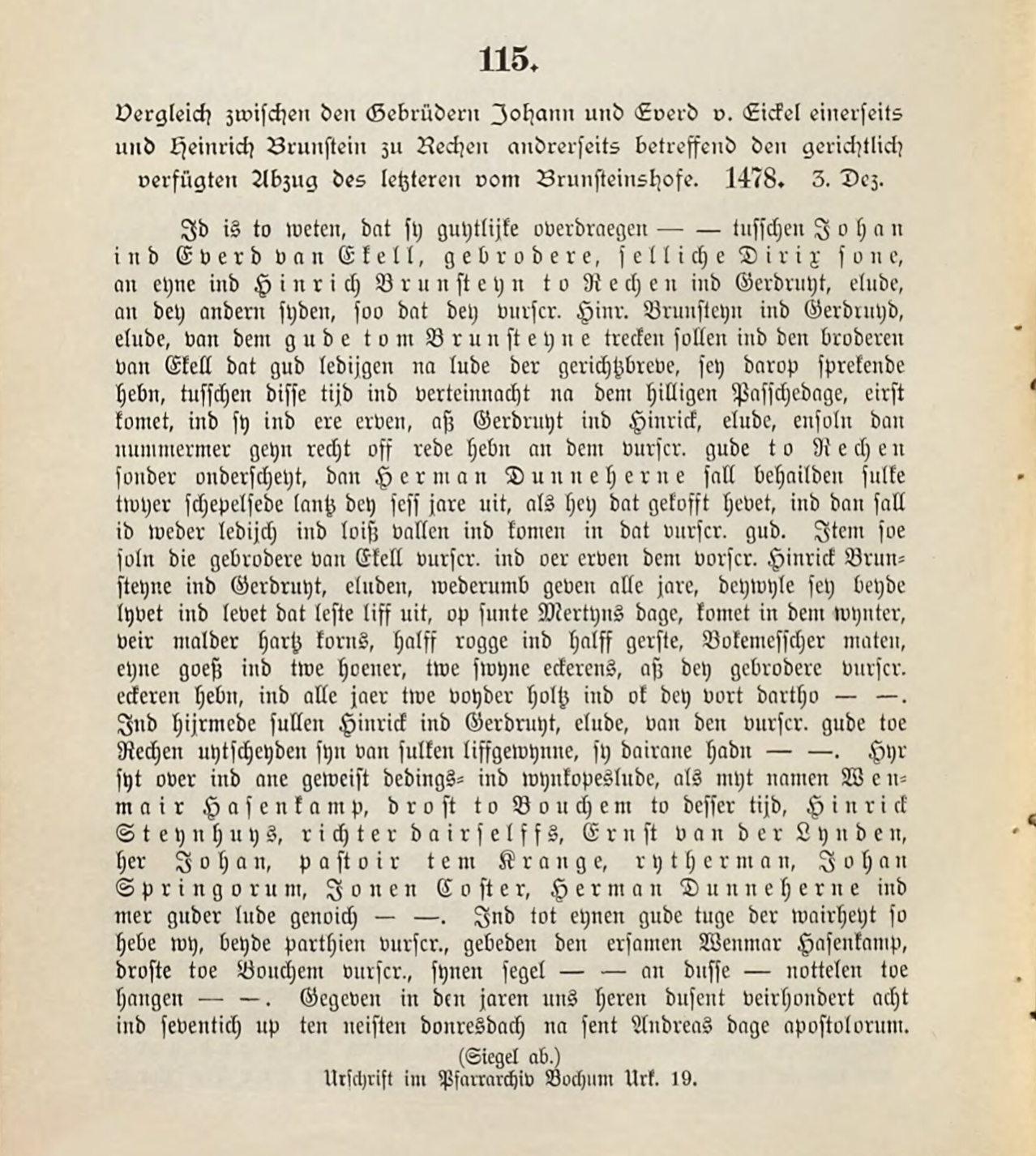
Reference: Settlement on the Eviction from the Brunsteinshof at Rechen
Settlement over Debt
24 April 1486 · Lütgendortmund, Kloster Marienborn
On 24 April 1486, a legal settlement was concluded before clerical and civic representatives concerning a debt of 35 Rhenish guilders owed by the late Gerd Puttman to his sister Stine tom Putte. The agreement required Hermann Puttman, Gerd’s son, to pay an annual grain rent of nine scheffels—half rye and half barley—from land at the Cruceacker near Altenbochum, with provisions for redemption and distraint in case of default. The charter was witnessed by several officials, among them Johann Springorum, and illustrates late medieval practices of securing monetary obligations through agricultural rents.
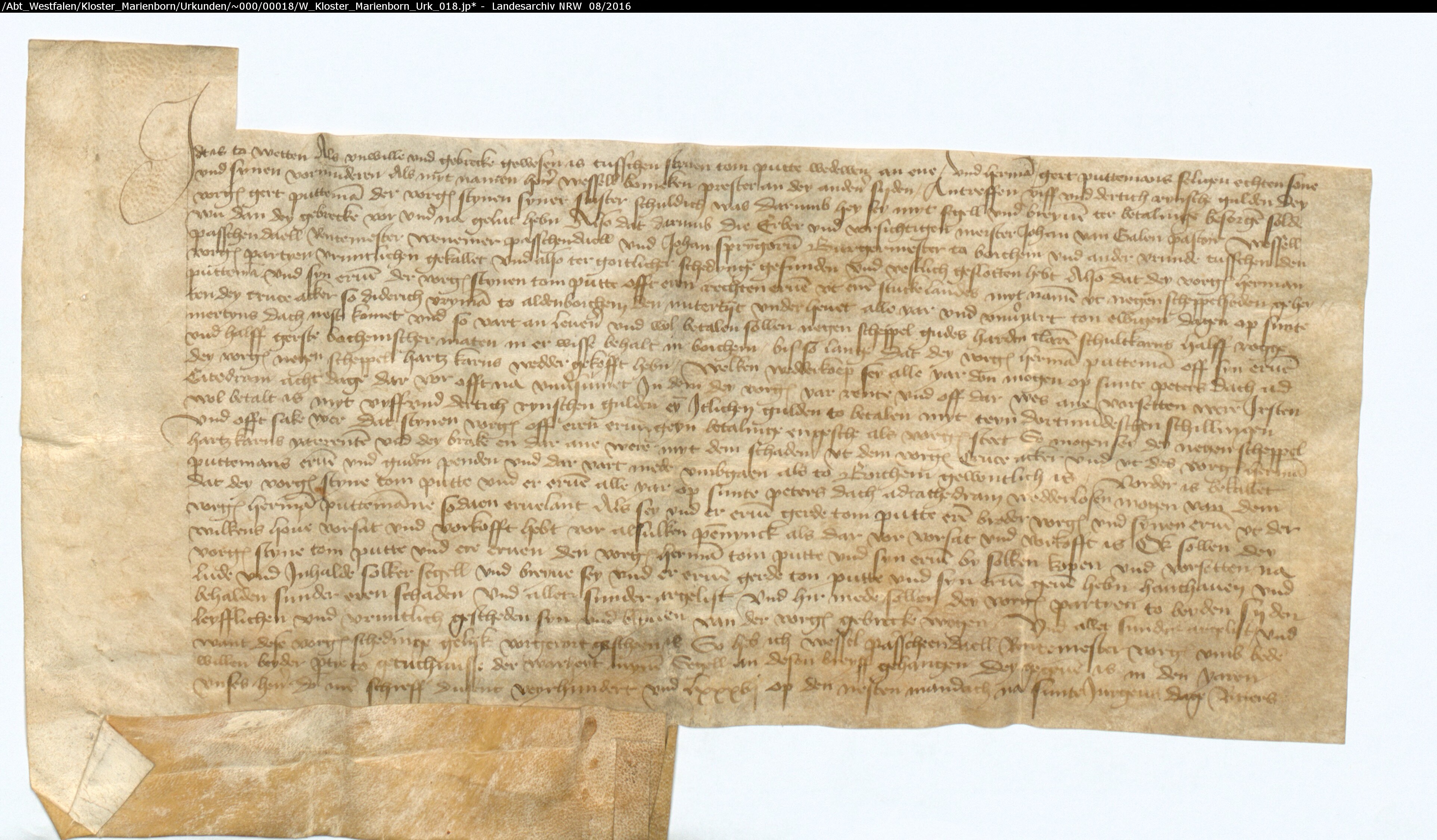
Reference: Settlement over Debt
Family
Parents
- ♂ Dietrich Springorum (c. 1395 – ?)
- ♀ Karden
Partner(s) & Children
- ♀ Nese Springorum (c. 1445 – ?)