Diederich Springorum

Diederich Springorum is one of the earliest securely documented member of the Springorum family in Bochum and appears in a relatively large number of mid-15th-century legal records, indicating a sustained presence in the town’s documentary record. A particularly significant deed from 1441 records his sale of an annual monetary rent from his house and farmstead behind the Bungener house and explicitly names his wife and sons, providing rare early evidence for the composition of the Springorum family and marking the starting point of the documented lineage. Later records show Diederich as a property owner, lender, administrator, and legal witness, roles that reflect financial security, literacy, and a respected position within the Bochum community; together with his wife Karden, he stands at the beginning of the documented history of the Springorum family.
Events & References
Monetary Rent Sale
14 February 1441 · Bochum, Deutschland
On 14 February 1441, Diederich Springorum sold a yearly rent of half a mark from his house and farm in Bochum, located behind the Bungener house, to Karden von Beckum. The sale was made with the explicit consent of his wife Karden and his sons Baten and Johann, as required to protect family and inheritance rights, and was formally confirmed before the Bochum magistrate Wennemar Paskendal and other witnesses. This document is particularly important because it is the earliest record in which Diederich appears and, at the same time, clearly identifies his wife and children, making it a key source for understanding the earliest documented family relationships within the Springorum lineage.
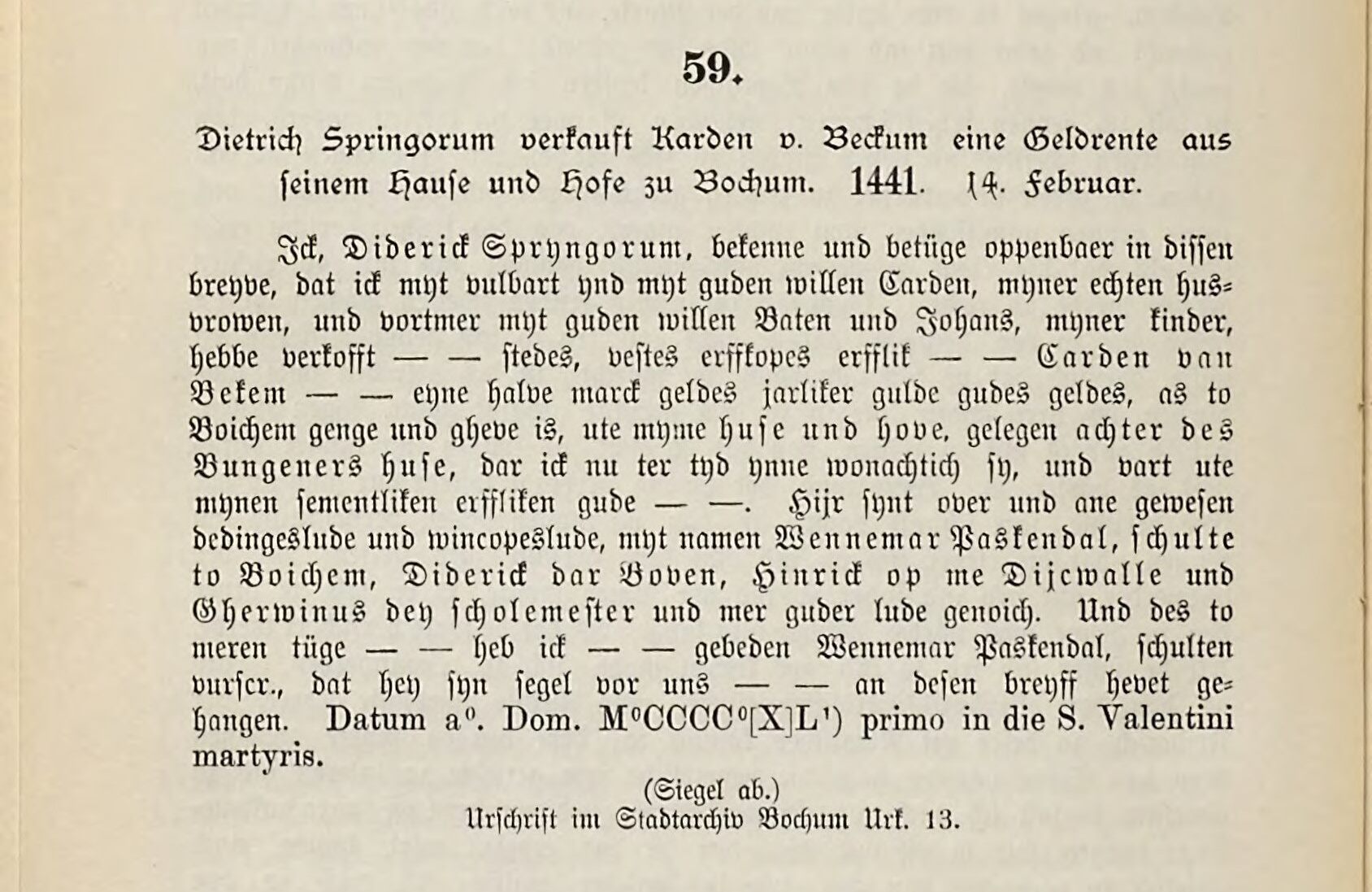
Reference: Monetary Rent Sale
Inheritance Seizure Notice
31 March 1454 · Bochum, Deutschland
In March 1454, Diederich Springorum of Bochum issued a formal notice concerning the seizure and sale of two horses pledged by Johann van Galen, son of Wessel, as security in an inheritance dispute relating to the estate at Oefte. The horses were sold in Bochum according to local custom, and the document records the purchase prices, associated costs, and the accounting of proceeds, resulting in a remaining balance of one hundred guilders and four denarii. As Diederich Springorum possessed no personal seal, the notice was sealed on his behalf by Diderick Conninge of Bochum and publicly confirmed on Laetare Sunday.
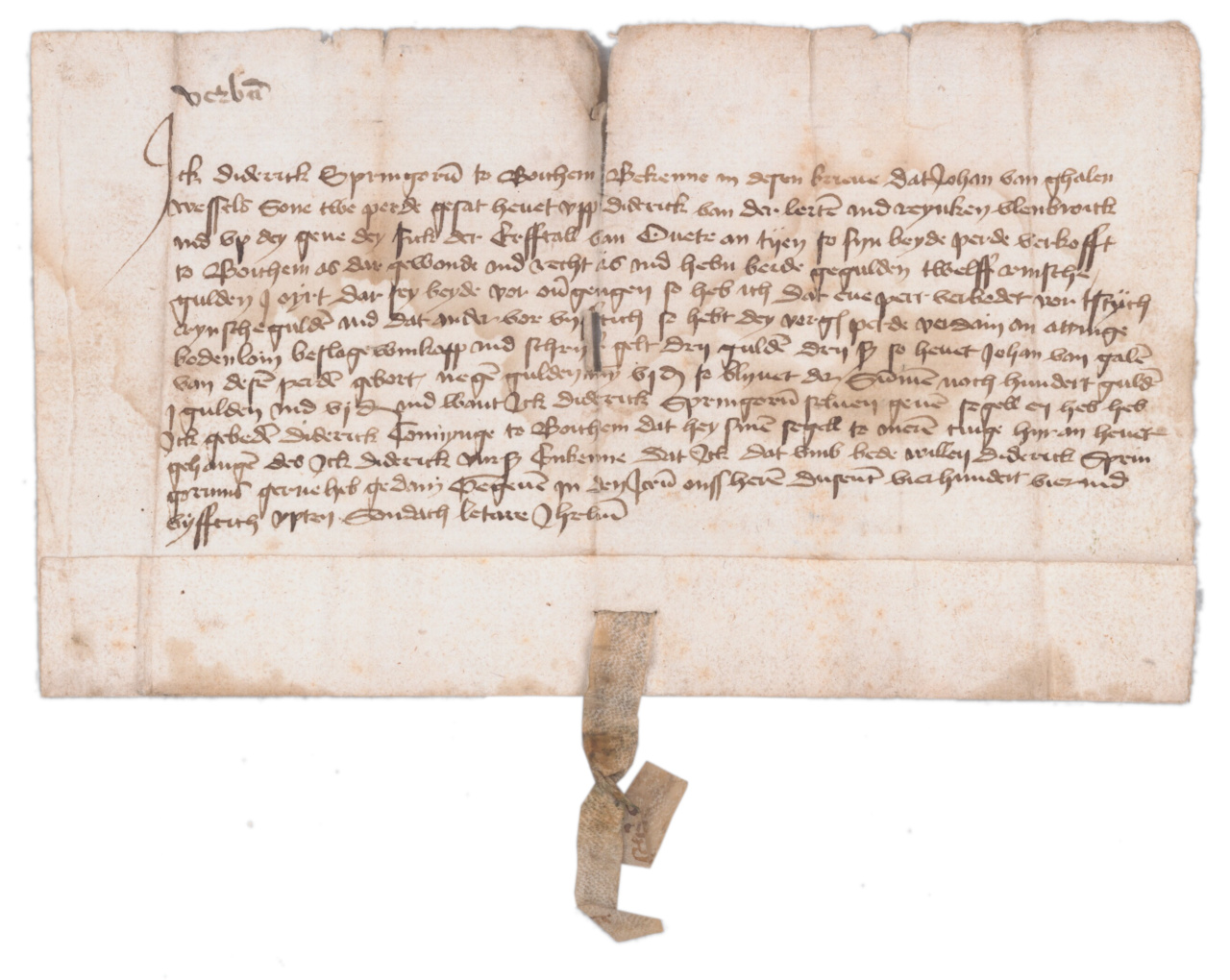
Reference: Inheritance Seizure Notice
Grain Pledge Charter
16 February 1456 · Bochum, Deutschland
In February 1456, Diderich Splythoff and his wife Telse pledged two malter of debt grain—half rye and half barley, measured according to the Bochum standard—from their farm in Bochum as security for a loan of twenty Upper Rhenish gold guilders. The pledge was granted to Diederich Springorum, who thereby acquired the right to receive the specified quantity of grain annually until redemption. The transaction was formally recorded before the court of Bochum in accordance with local legal custom.
Reference: Grain Pledge Charter
Grain Pledge Charter
16 May 1457 · Bochum, Deutschland
In May 1457, Johan van Havekenscheide acknowledged before the court of Bochum that he owed nine Rhenish guilders to Bitter Holinghe, or to the lawful bearer of the charter, and pledged an annual rent of one malter of grain—half rye and half barley, measured according to the Bochum standard—from his estate at Gerte, known as the Schraegengut, as security for the debt. The transaction was concluded before the judges Herman and Iserheyll Reneschen and formally authenticated by their seals. A group of named witnesses, including Diederich Springorum, attested to the legality and validity of the pledge.
Reference: Grain Pledge Charter
Charter of Sale of the Brunstein Hof at Rechen
10 May 1459 · Bochum (Freigericht) / Rechen (estate location)
On 10 May 1459 Johann von Eickel, son of the late Henneken, declares that he has lawfully sold the feudal holding known as the Brunstein Hof, located at Rechen, to Heinrich Brunstein of Westerhem and his heirs. The transaction is confirmed in the presence of witnesses—including Dirick Springorum—and is sealed by Johann von Eickel as well as by the two Freigrafen (free court judges) of Bochum, Wyneke Possendale and Johann Hokenberg.
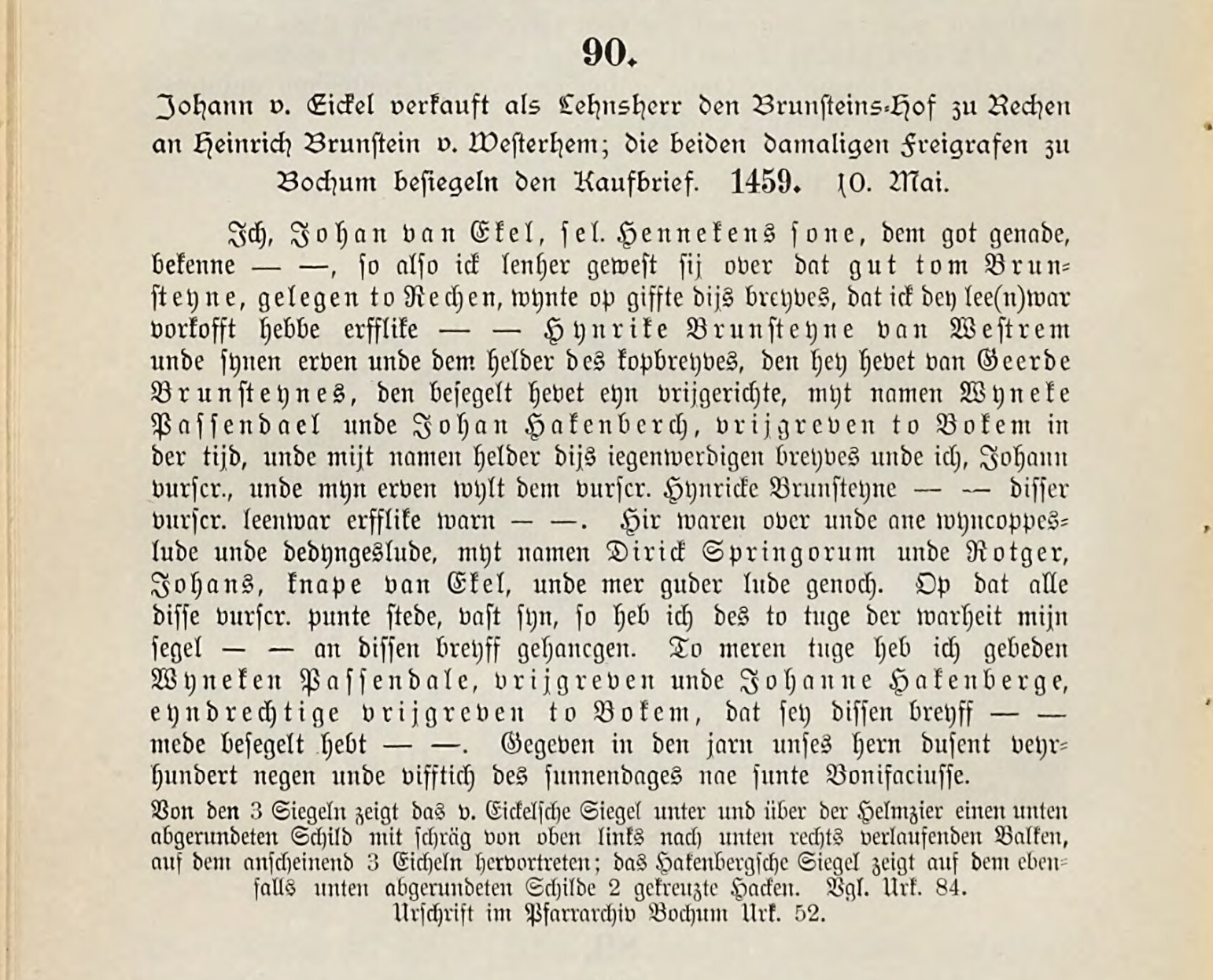
Charter of Sale of an Annual Grain Rent from a House and Farm in Bochum
23 November 1461 · Bochum
On 23 November 1461, Johann Steinhut and his wife Else sold an annual grain rent to Herman Kremer, consisting of half rye and half barley, to be delivered each year from their house and hereditary property in Bochum. The agreed purchase price was nine heavy Rhenish gold guilders, fully paid at the time of transfer. The transaction was formally confirmed before the mayors and council of Bochum, sealed with the city seal, and witnessed by several local citizens, including Diederich Springorum.
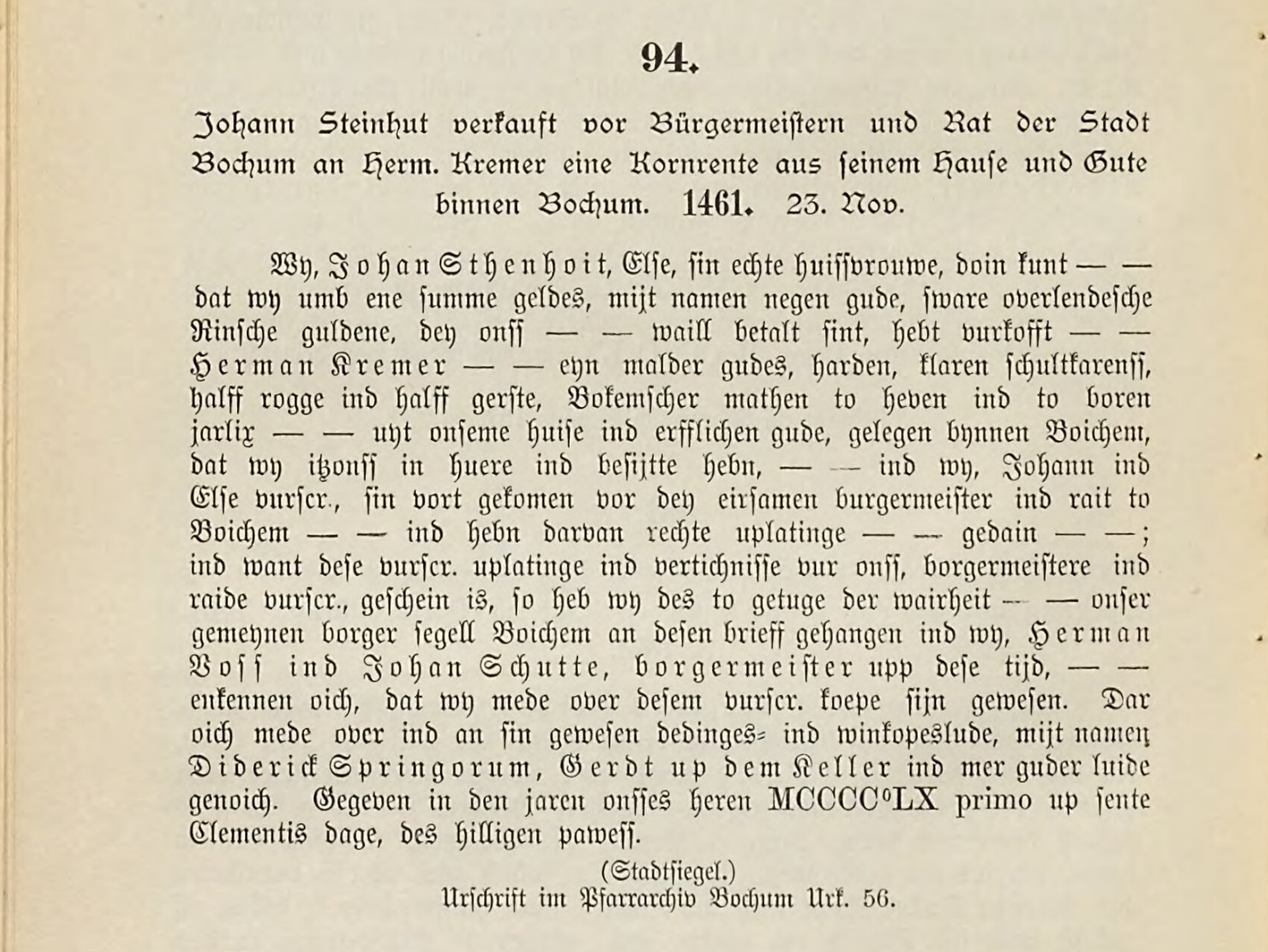
Reference: Charter of Sale of an Annual Grain Rent from a House and Farm in Bochum
Family
Partner(s) & Children
Karden (wife)
- ♂ Johann Springorum (der Ältere) (c. 1420 – ?)
- Baten Springorum