The Springorum Research Project
Inside My Research
A behind-the-scenes look at how I approach genealogy and archival research. This is where I’ve gathered the links, tips, and tools I actually use when working through archives and turning individual records into a broader family narrative. Part guide, part toolkit, it reflects how I work in practice—and I hope it proves useful, and maybe even a little inspiring, for anyone on their own research journey.
Getting Started Fast
I started my research on MyHeritage, a commercial genealogy platform with a very useful Smart Matches feature that quickly points to possible links in other family trees. Because the name Springorum is quite rare, I found matches almost immediately and was able to outline two main branches: the German line descending from Reinhard Springorum, in Germany, and my own ancestors traced back to Willem Springorum in Amsterdam.
It didn’t take long, however, to notice that many of these connections were simply wrong. I came across children supposedly born before their fathers, brothers more than fifty years apart in age, and the same person duplicated and linked to entirely different sets of parents. What became obvious is that many people on myHeritage seem to blindly copy information from other trees without checking it. The same errors show up again and again on almost every page where a person is mentioned. That was the moment I realised I had to stop trusting matches and start verifying everything, one source at a time.
In the end, I think this comes down to a kind of “completeness bias”: the urge to fill every empty box in a family tree, even if the data behind it is shaky. For many, a complete family tree seems more important than an accurate one. That realisation was the final push for me to slow down, question every link, and treat completeness as something earned through evidence—not something to be assumed.
Looking for Evidence

As the next logical step, I turned to online archives to verify and extend my findings. I first familiarized myself with the wide range of archival platforms available in both the Netherlands and Germany—each with its own scope, structure, and quirks. From national and regional archives to church and municipal collections, these websites became my primary gateways into the past.
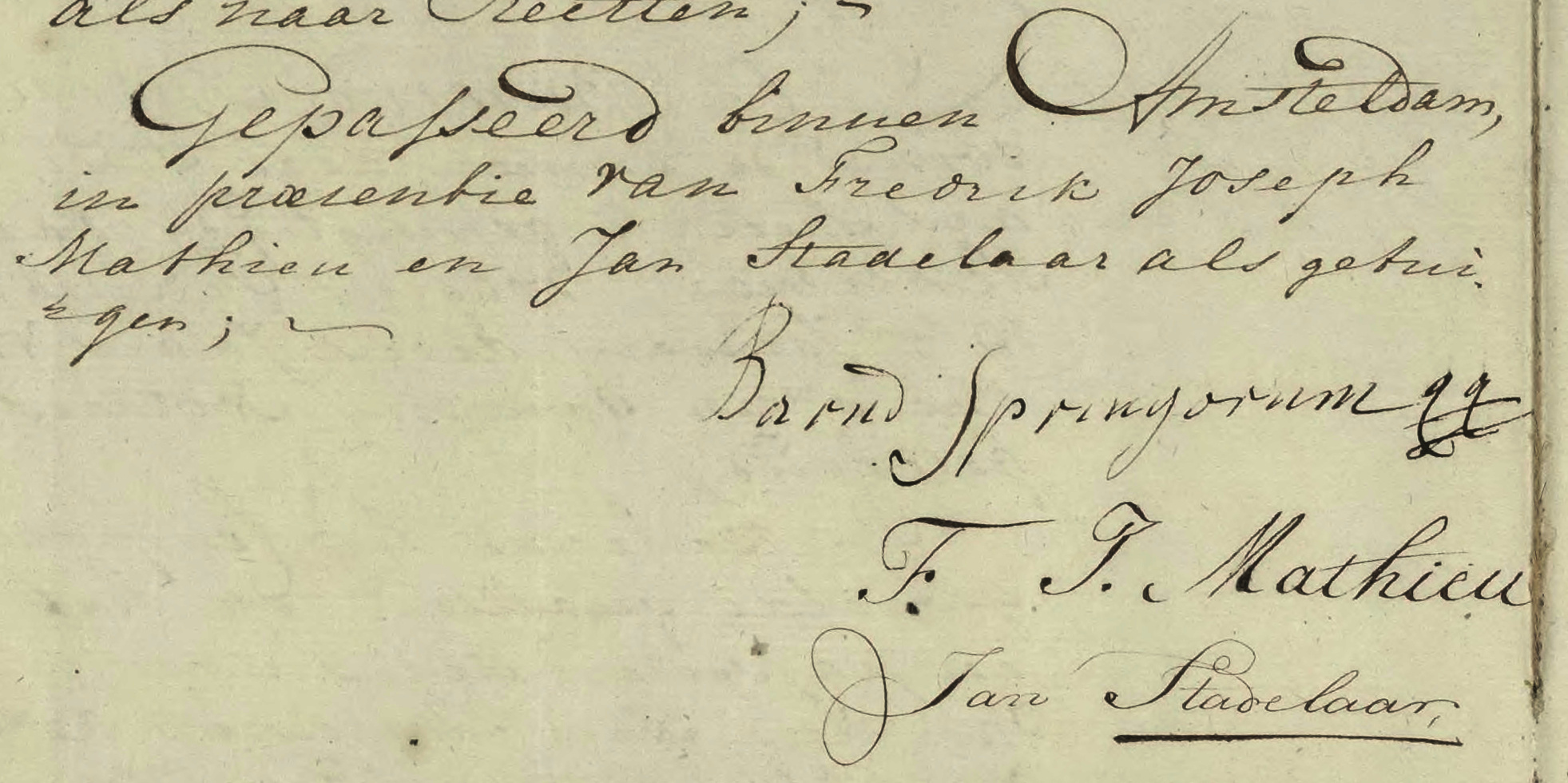
Using these resources, I searched church books for birth and baptism entries, consulted population registers, and worked through a variety of digitized record series. Much of this material was not indexed, which meant spending countless hours scrolling through scans, page by page, carefully examining handwriting and context in search of even the smallest reference to the Springorum name.
Linking the Branches

One of the central challenges of this research was establishing a reliable link between the Amsterdam branch of the family and its German—more specifically Dortmund—origins. While both branches were well documented in their own right, the transition from one to the other proved frustratingly elusive. For a long time, the records seemed to stop just short of the point where the two lines should meet.
Traditional archival sources alone did not provide the decisive proof needed to bridge that gap. The breakthrough came from an important DNA match, which confirmed that the Amsterdam Springorums are indeed connected to descendants of the Dortmund family. Although this result did not immediately reveal the exact genealogical path, it provided the crucial assurance that the two branches belonged to a single family line—making it possible, at last, to merge the two trees into one continuous lineage.
Bringing It All Together

Over time, my research grew beyond a collection of isolated findings. I began documenting everything systematically in spreadsheets and text files, recording sources, hypotheses, and small details that might later prove significant. This worked for a while, but as the amount of material increased, it became clear that I needed a more structured and sustainable way to organise—and present—what I was learning.
That realisation led to the creation of a dedicated website. Building it allowed me to bring people, events, sources, and interpretations together in one place, and to show not just the conclusions, but also the path that led to them. Making the research publicly accessible also felt important: genealogy gains value when it can be checked, questioned, and built upon by others.
For now, the site is hosted on my personal server—partly for practical reasons, and partly because running and maintaining such a setup is another of my long-standing interests. At some point in the future, I may move the project to a professional hosting provider, but for the moment this arrangement gives me the flexibility to keep refining both the research and its presentation.
Quality Over Completeness

I’ve come to realize that building a fully complete and perfectly accurate family tree is an unattainable goal. Much of the data—especially on my Springorum site at MyHeritage—remains unverified. In contrast, the information on my Springorum site at Geneanet offers a more polished and fact-checked version of at least the direct male family line, free from questionable inherited data, as it is taken directly from my personal Gramps files. Therefore, I’ve set the following priorities for my research:
- The direct male family line starting with Reinhard Springorum
- My own direct male ancestors
- Extended family members who carry the Springorum name
- Direct ancestors with other surnames
MyHeritage now mainly serves as a source of new leads for my research. When new connections are discovered, I verify the information, consolidate the records offline in Gramps, and then export them to Geneanet.
From Research Practice to the Name Itself
Here I showed how individual records are gathered and interpreted. But behind every document lies a more fundamental question: where does the name Springorum come from? To explore that deeper layer, the story continues on the etymology page.
Next read: It’s All in the Name →
Supporting the Research
This website is maintained as an independent research project. Contributions help cover archive access, digitisation, and hosting costs.
Support is entirely voluntary and greatly appreciated.