It’s All in the Name
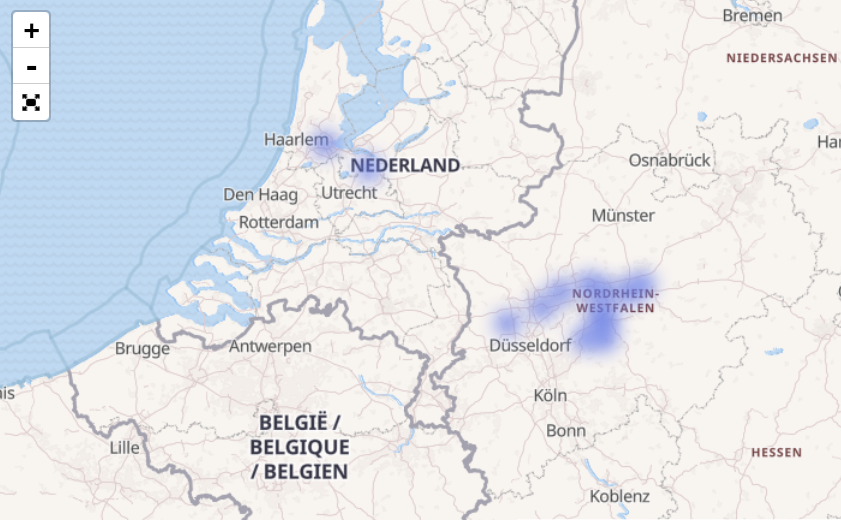
The surname Springorum is rare, very rare. Those who carry it most likely trace back to a common ancestor, making them distant relatives. This map helps test this idea by showing where the name is most concentrated. If there's only one hotspot, it likely points to a single family line. In this case, though, two clear hotspots stand out: one in Nordrhein-Westfalen and another near Amsterdam/Utrecht. They’re not far apart, but the key question is this—are the Springorums in these two regions actually connected?
Where the Name Appears Over Time
The European genealogy portal Geneanet lists 438 individuals with the surname Springorum. The distribution, from 1600 to the present, is based on entries in the Geneanet database.
| Rank | Place | Country | Individuals |
|---|---|---|---|
| 1 | Schwelm | Germany | 479 |
| 2 | Unna | Germany | 292 |
| 3 | Amsterdam | Netherlands | 282 |
| 4 | Herdecke | Germany | 205 |
| 5 | Dortmund | Germany | 85 |
| 6 | Hagen | Germany | 33 |
| 7 | Wengern (Westphalia) | Germany | 26 |
| 8 | Breckerfeld | Germany | 24 |
| 9 | Mülheim an der Ruhr | Germany | 20 |
| 10 | Hemmerde (Westphalia) | Germany | 19 |
| 11 | Sprockhövel (Westphalia) | Germany | 16 |
| 12 | Gelsenkirchen | Germany | 16 |
Source: https://nl.geneanet.org/familienamen/SPRINGORUM
The genealogy portal Forebears lists 331 individuals with the surname Springorum. What is interesting is to see that The Netherlands is only ranked third, after South Africa.
| Rank | Country | Individuals |
|---|---|---|
| 1 | Germany | 197 |
| 2 | South Africa | 73 |
| 3 | Netherlands | 41 |
| 4 | Czechia | 4 |
| 5 | Scotland | 4 |
| 6 | United States | 4 |
| 7 | England | 2 |
| 8 | Ireland | 1 |
| 9 | Australia | 1 |
| 10 | Ivory Coast | 1 |
| 11 | North Macedonia | 1 |
| 12 | Switzerland | 1 |
| 13 | Thailand | 1 |
Source: https://forebears.io/surnames/springorum
It seems the South African Springorum branch originates from Carl Hermann Wilhelm Springorum (1857-1911) who migrated from Düsseldorf to Pretoria in the late 19th century.
Possible Origins of the Name Springorum
The surname Springorum has deep roots in the city of Bochum, where records show the family using this name as early as the 15th century. The name was likely already in use long before it first appeared in documents, suggesting a tradition that stretches back even further.
How the Name Came to Be
In medieval German cities, surnames weren’t fixed right away. People were often known only by their baptismal names, but as cities grew, there was a need to tell citizens apart. Names started to reflect where someone came from, their house, their job, or even their personality. Craftsmen, in particular, sometimes got humorous or teasing nicknames—like Lisegang (for a sneaky person) or Schiller (the squinting one).
The name Springorum probably falls into this category. It’s thought to come from a phrase like "Springherum," meaning someone who "jumps around" or is lively and industrious. This fits with other names of the time that started with "Springe," such as Springer (a fast messenger) or Springinsfeld. The ending "-orum" might have evolved from "-um," a common suffix in place names, but in this case, it’s more likely tied to the playful, descriptive nature of early surnames.
A Different Take: The Sacred Spring Theory
Some researchers, like von Wecus, suggested that Springorum could be linked to a sacred spring or well—a place of importance in ancient Germanic culture. They broke it down as "Spring" (spring or well) and "Horum" (enclosed place). However, this idea has been widely criticized by experts. The name doesn’t seem to match known place names, and the theory itself is seen as unscientific. Most scholars agree that Springorum is more likely a descriptive surname, not a place name.
Why This Matters
The story of the Springorum name is a window into how people were identified in the past. It reflects the creativity and humor of medieval city life, where a name could capture someone’s spirit or even their quirks. For anyone with the name Springorum, it’s a reminder of a lively history—one that began in the streets of Bochum and carried on through generations.
What do you think? Does this interpretation resonate with what you’ve heard about the name, or does it spark new questions about your own family’s past?
How the Name Springorum Appears in Historical Records
Spelling variations are common in historical documents, especially before the 20th century. Standardized spelling simply didn’t exist, and names were often written phonetically. The surname Springorum is quite rare and has a distinctive Latin-Germanic form, so major spelling variations are uncommon. However, over the centuries—especially in older handwritten records—we encounter a few variations:
- Springorum (Most modern records)
- Springhorn, Springhoorn (German dialect spelling)
- Sprinckhorn, Sprinckhoorn, Sprinckhooren (Phonetic variants)
- Sprinkhoorn
- Springhorum
- Springori
- Springoorum
- Springcorum
- Springoreym
For wildcard searches in archives I use sprin*or* which catches most of these variations
When Names Became Symbols
Etymology explains how the name Springorum came into being, but not how the family chose to represent itself. At some point, names turned into symbols. To explore how the Springorum identity was expressed visually—and how later generations remembered it—we turn to the family’s coat of arms.
Next: Springorum Coat of Arms