Springorum Coat of Arms
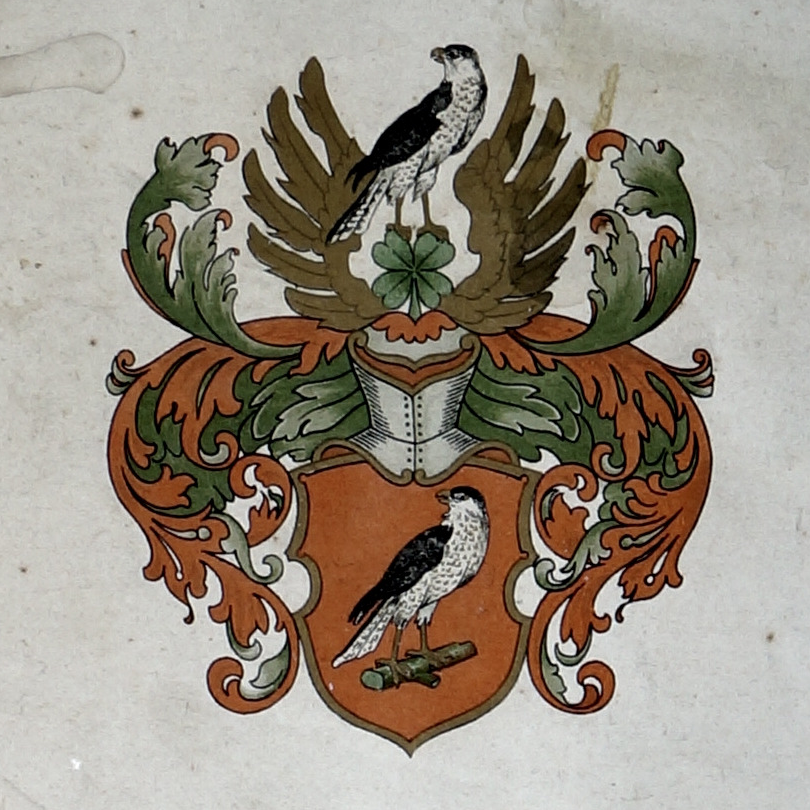
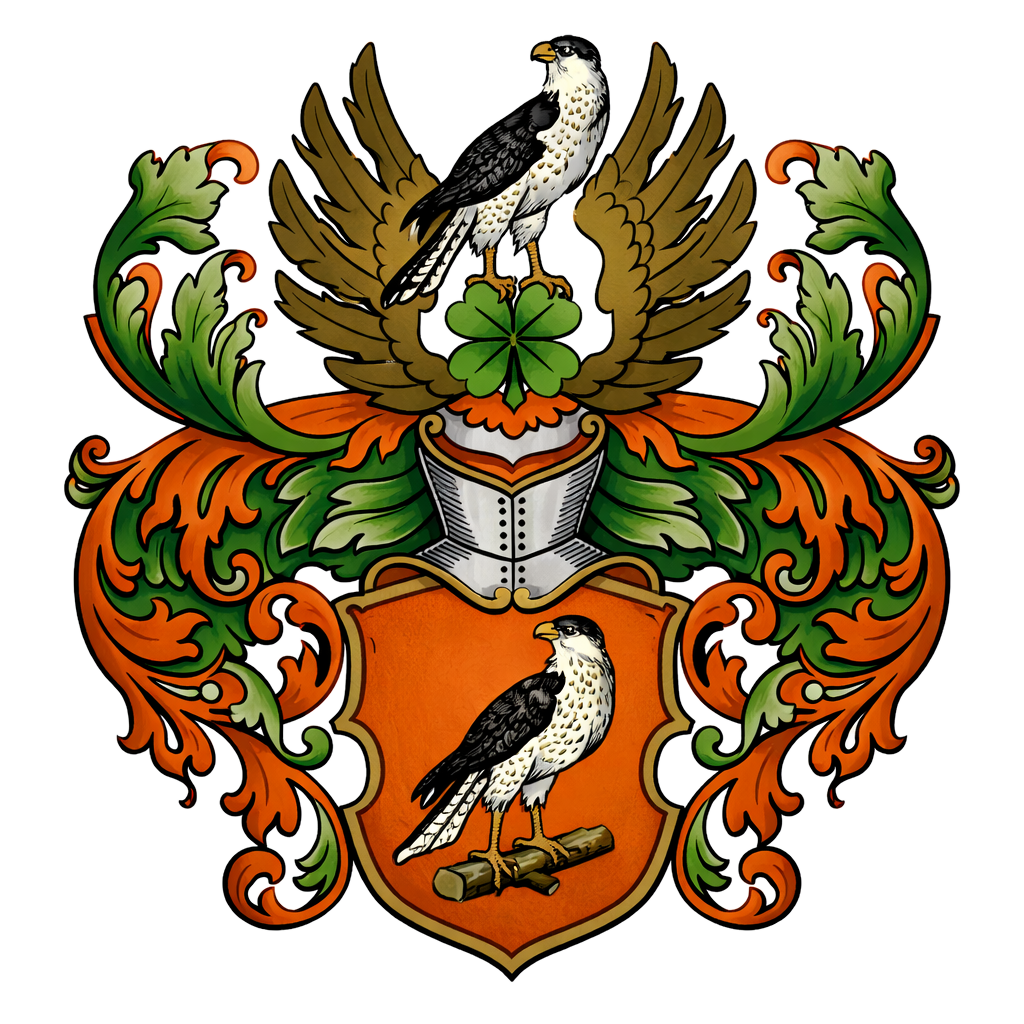
The late mining director Friedrich Springorum (1845–1924), who devoted considerable effort to researching the history of his family, commissioned the well-known genealogist and schoolteacher Barich[1] of Dortmund between 1895 and 1900 to compile printed genealogical tables (Stammtafeln) for the Springorum family. These tables are still preserved by older members of the family today. The first of these tables displays, in the upper left corner, a hawk (sparrowhawk) presented as the Springorum coat of arms.
According to Dr. Höfken, inquiries among the older generation regarding the origin of this coat of arms yielded no clear explanation as to its provenance or the reason why the sparrowhawk was chosen as the heraldic animal. Höfken suggests that Barich likely associated the name Springorum with the name of this bird and therefore selected it as the emblem.
Dr. Höfken further notes that, at the time of his writing, this coat of arms had not been documented on any contemporary written records or seals. He does, however, draw attention to a related piece of evidence: a coat of arms that once appeared on the gravestone of Georg Philipp Overweg, councillor of Westhofen, who died in 1811. This gravestone stood in the old churchyard at Hohensyburg.
The stone was a three-part monument. The central inscription commemorated Overweg himself, while the inscriptions on either side were dedicated to his first wife Anna Katharina Elisabeth Springorum (1736–1778) and his second wife Anna Sibilla Helene Rumpaeus. Above these inscriptions were three recessed compartments intended to display the family arms of the three deceased individuals. By the time Höfken recorded his observations, these recesses—like the inscriptions beneath them—had become completely weathered. About a generation earlier, however, heraldic symbols were reportedly still discernible.
According to this recollection, above the grave of the née Springorum one could make out a helmet surrounded by foliate ornamentation; beneath it a four-leaf clover; and below that the faint figure of a bird, barely visible in the eroding sandstone.
On the basis of this evidence, Dr. Höfken concludes that it can be stated with reasonable certainty that the Herdecke branch of the Springorum family bore a coat of arms at the end of the eighteenth century featuring a four-leaf clover with a bird beneath it, although the precise identification of the bird was already lost at that time. Knowledge of this coat of arms subsequently faded.
Höfken records that awareness of the old gravestone was revived only through the genealogical research of the late August Overweg, former Landeshauptmann and a close associate of Wilhelm Springorum of Elberfeld. It was following this rediscovery that the genealogist Barich, working at the turn of the twentieth century, reconstructed the coat of arms and selected the sparrowhawk as the heraldic animal.
When Symbols Were Not Enough
Coats of arms preserve memory, tradition, and identity, but they do not prove descent. While heraldic traces offer valuable context, they cannot by themselves connect the German and Dutch Springorum branches. To move beyond symbols and attribution, a different kind of evidence was needed.
That evidence came from DNA research.
Next: DNA Match
In a Dortmunder Zeitung newspaper index from February 1884, there is an entry for “BARICH, Friedrich, Lehrer aus Kirchhörde, in Marten” — which indicates a teacher named Friedrich Barich living in the Dortmund area (specifically from the suburb Kirchhörde, noted under Marten in that issue). Link: https://wiki.genealogy.net/Zufallsfunde_aus_der_Dortmunder_Zeitung%2C_Februar_1884?utm_source=chatgpt.com. ↩︎