Beiträge zur Geschichte der Familie Springorum in der Zeit von 1700 - 1800
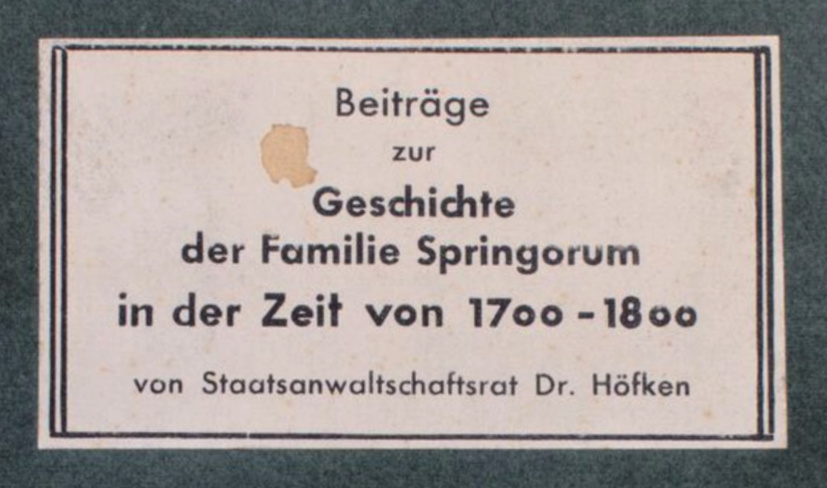
Dr. Günther Höfken’s Beiträge zur Geschichte der Familie Springorum in der Zeit von 1700–1800 (1935) is one of those rare works that doesn’t just recount history—it uncovers the threads that connect a family across generations. While the study explores the Springorums’ roles as merchants, landowners, and civic leaders in the Ruhr region, its real significance lies in the quiet revelations buried within its pages. For years, there had been whispers, assumptions, and fragments of evidence suggesting that Johann Heinrich Springorum was the son of Pfarrer Johannes Springorum. But it wasn’t until Höfken’s meticulous research, almost in passing, that this connection was finally confirmed.
That single detail—Johann Heinrich’s place as one of the five sons of Pastor Johannes—wasn’t the study’s main focus, but it felt like the missing piece of a puzzle I’d been trying to solve. It was the kind of confirmation that shifts everything, turning speculation into certainty and filling in a gap that had lingered for far too long. The study didn’t set out to prove this relationship, yet there it was, tucked between discussions of land records and civic roles, as if it had been waiting to be found.
Höfken’s work also paints a broader picture of the Springorums’ world, placing them within the economic and political shifts of the 18th century. The family’s involvement in trade, land ownership, and early industrial ventures wasn’t just about survival—it was about shaping their surroundings. But for me, the real magic of this study is how it quietly answered a question that had been lingering for generations. Sometimes, the most meaningful discoveries aren’t the ones you go looking for—they’re the ones that find you when you least expect them.
This study isn’t just a record of the past; it’s a reminder that history is often hiding in plain sight, waiting for someone to notice. For anyone tracing the Springorum name, Höfken’s work is more than a resource—it’s a moment of clarity, a confirmation of what was always suspected but never proven. And in that sense, it’s invaluable.
- Title: Beiträge zur Geschichte der Familie Springorum in der Zeit von 1700 - 1800
- Author: Dr. Günther Höfken
- Date: 1935
- Links:
- Download: Beiträge zur Geschichte der Familie Springorum in der Zeit von 1700 - 1800 - Dr. Höfken (20 MB)