The Springorum Name: Family History and Origins
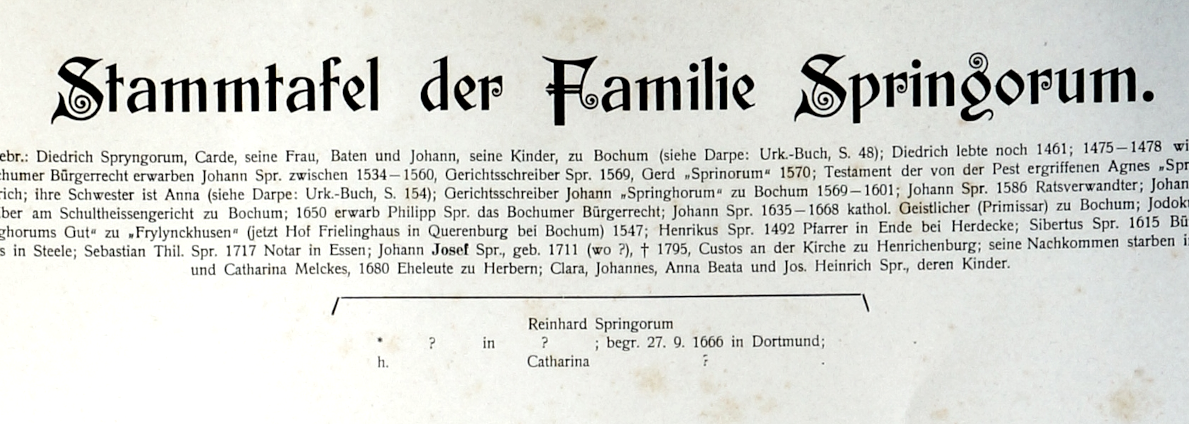
Outline of the Springorum history
This site documents the history of the Springorum name: where it first appears, how it developed over time, and how different branches of the family took shape across regions and generations. The surname is rare and historically concentrated in Westphalia, Germany, with the earliest documented occurrences found in and around Bochum from the fifteenth century onward. These early references provide context for the name, but do not yet form a single, continuous family line.
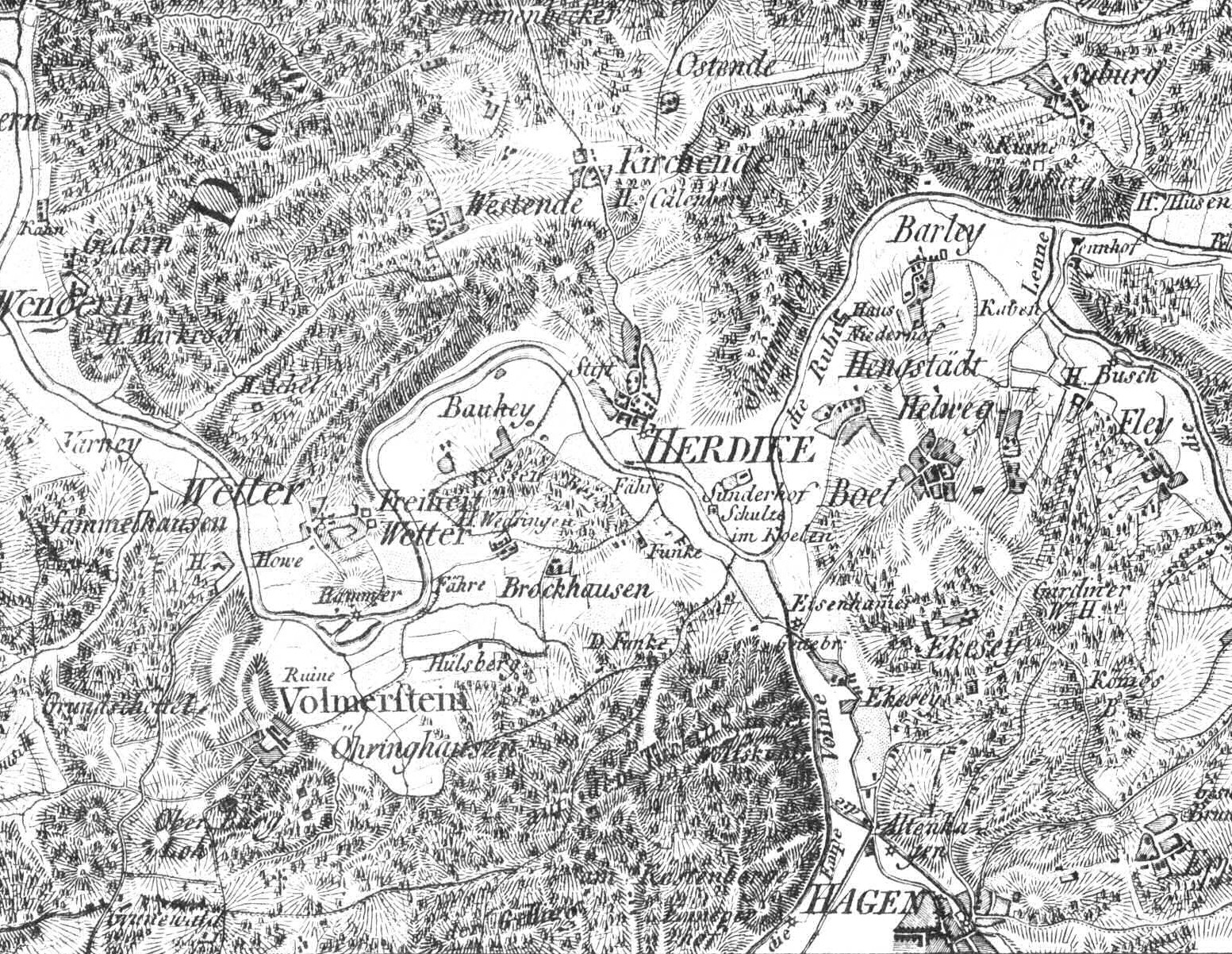
From this Westphalian core, members of the Springorum family gradually appear elsewhere. In the seventeenth century, the documentation becomes denser in the Dortmund and Ruhr area, allowing a clearly traceable line of descent to be followed across successive generations. By the mid-eighteenth century, this line reaches a turning point with the move to Amsterdam, where the family establishes a lasting and well-documented Dutch branch.
The structure of this project reflects those historical phases. Separate sections examine the early origins of the name, the formation of a documented family line in Westphalia, and the later settlement in Amsterdam. Alongside these main chapters, the site also records isolated or early mentions of the name that do not lead to known descendants, as well as individuals whose place within the wider family remains uncertain.
Throughout the site, variant spellings found in historical records are noted where relevant, but treated within a single broader Springorum context unless evidence indicates otherwise. All conclusions are grounded in archival sources, with clear distinctions made between proven connections and plausible but unconfirmed hypotheses.
Generations are counted from the earliest securely documented ancestor (Gen 0). His children form Gen 1, their children Gen 2, and so on. Any earlier, estimated or hypothetical generations are assigned negative generation numbers (Gen –1, Gen –2, etc.), making clear that these precede the securely proven lineage.
Origins (1400–1600)
 — a man positioned at the heart of late-medieval Bochum. Serving as Bürgermeister in 1476, he moved through a world of council meetings, property matters, and civic obligation, where authority was negotiated face to face and recorded in parchment. In a town still finding its political shape, his role reflects responsibility, continuity, and the early public presence of the Springorum name.](/people/johann_springorum_c1420/johann_springorum_c1420.jpg)
The earliest known occurrences of the Springorum name appear in and around Bochum in late-medieval Westphalia. This section gathers those early references and places them within their historical and social context, long before a continuous family line can be firmly established.
At this stage, the reconstruction relies almost entirely on Urkunden—charters documenting property transfers, debts, offices, and legal agreements. While baptismal, marriage, and death registers from this period are missing, the surviving records are rich enough to trace relationships and successive generations with surprising clarity. I consider myself lucky: many of the Springorums held official positions as city scribes, and some even served as Bürgermeister. Because of their roles, they were mentioned in numerous Urkunden, leaving behind a trail of documents that would otherwise be much harder to follow.
Thanks to a few key sources—especially the testament of Agnes Springorum—it’s possible to piece together nearly all the Springorums from this era and connect them into a cohesive family network. These records offer a rare glimpse into the lives of early Springorums, allowing fragments of their stories to emerge long before parish administration began keeping systematic records.
Lineage (1600–1750)
 (1625-1694) — the pivotal figure from whom perhaps all present-day Springorums in both Germany and the Netherlands descend. As a parish priest, he stood at the center of community life. From his five sons, multiple branches spread outward, forming the backbone of the later Springorum lineage.](/people/johannes_springorum_1625/johannes_springorum_1625.jpg)
From the early seventeenth century onward, the Springorum family can be traced generation by generation in the Dortmund and Ruhr area. As parish and civic records grow more detailed, a continuous and documentable line of descent begins to take shape.
With Reinhard Springorum (1593–1666), Stallmeister in Dortmund, the trail becomes firmly established. While earlier generations appear only in fragments, Reinhard’s family marks the point at which the Springorum name becomes continuous, traceable, and enduring—moving from isolated mentions to a lineage that can be followed across time, place, and successive generations.
Though no direct records link Reinhard to the Springorums of Bochum, the connections are compelling. His wife, Catharine Vasolt, belonged to the Vasolt family of Bochum, and both the Springorum and Vasolt names were extremely rare in the region during this period. These ties strongly suggest a family relationship between Reinhard and the earlier Springorums of Bochum, even if the exact nature of that connection remains just out of reach. What is clear, however, is that Reinhard’s life and descendants anchor the Springorum story in a way that earlier records simply cannot.
Amsterdam (1750–1950)
 — a man who found his way upward in early-twentieth-century Amsterdam. He started as a liftboy at the Amstel Hotel, operating one of the early elevators. Over time, he worked his way up to become a waiter and later buffetchef, taking on more responsibility within the hotel.](/people/arnoldus_springorum_1887/arnoldus_springorum_1887.jpg)
With the arrival of Barend Springorum and Willem Springorum, one branch of the family enters a new urban and social setting in Amsterdam. This section traces the development of this Dutch line, following its establishment and continuity across multiple generations.
Unlike the earlier Westphalian period, the Amsterdam sources are far more complete and consistent. They reveal a family shaped by migration, work, and the opportunities of a growing city. From this point on, the lives of the Springorums in Amsterdam can be traced more clearly—in their professions, their neighborhoods, and their family connections over successive generations. While the Westphalian roots remain central to the family’s story, the Amsterdam records offer a detailed look at how this particular branch took shape and thrived in its new environment.
The Springorum Branch in South Africa
During the late 19th and early 20th centuries, members of the Springorum family left Europe for South Africa, drawn by opportunity and the promise of a new beginning. This branch traces its roots to individuals like Carl Hermann Wilhelm Springorum, who arrived with his family in 1893, and others who followed from both the Westphalian and Amsterdam lines. Passenger lists and civil records document their journeys, marking the start of a Springorum presence in regions such as the Transvaal and the Cape.
Today, around 73 people bearing the name Springorum live in South Africa. Their stories—from cane planters to professionals—reflect a family that adapted to a new environment while maintaining ties to its European heritage. This page explores the lives of these South African Springorums, their migrations, and how their experiences connect to the wider family history.
From early settlers like Carl and his descendants to later arrivals from Amsterdam, the South African Springorums represent a distinct chapter in the family’s global story.
→ read more (still works in progress)
Early Mentions and Lost Springorums
Even before the established Amsterdam branch emerged, the name Springorum appears from time to time in the city archives. These are isolated references — a registration here, a deed there — without it being immediately clear how these individuals relate to the later, better-documented family line.
Not everyone bearing the name Springorum fits directly into the known branches. In this section, I have therefore deliberately included individuals whose exact place within the family is (still) uncertain. In this way, the available evidence is preserved and made transparent, allowing possible connections to be established at a later stage.
For each of these entries, I have tried to determine whether a link exists with the German branch around Dortmund and Bochum. This was not always possible, but in several cases it has indeed been possible to make such a connection plausible — or even convincing. Didrig Springorum, for example, turns out to have been a cousin of Barend and Willem Springorum.
Next read: Springorum Origins in Bochum (1400–1600)
Supporting the Research
This website is maintained as an independent research project. Contributions help cover archive access, digitisation, and hosting costs.
Support is entirely voluntary and greatly appreciated.