Springorum Families in Amsterdam (1750–1950)
Settlement and Family Formation in Amsterdam
From the mid-eighteenth century onward, the Springorum family appears in Amsterdam records not as isolated individuals, but as a settled and continuous family presence. With the arrival of Barend and Willem Springorum, the family history enters a new geographic and social setting shaped by urban life, migration, and opportunity.
This page traces the development of the Amsterdam branch between 1750 and 1950, following successive generations as they established households, occupations, and long-term roots in the city. It also distinguishes this enduring Amsterdam line from earlier, more temporary appearances of the name, situating the Dutch branch clearly within the wider Springorum history.
Brief Historical Overview: Amsterdam 1750–1800
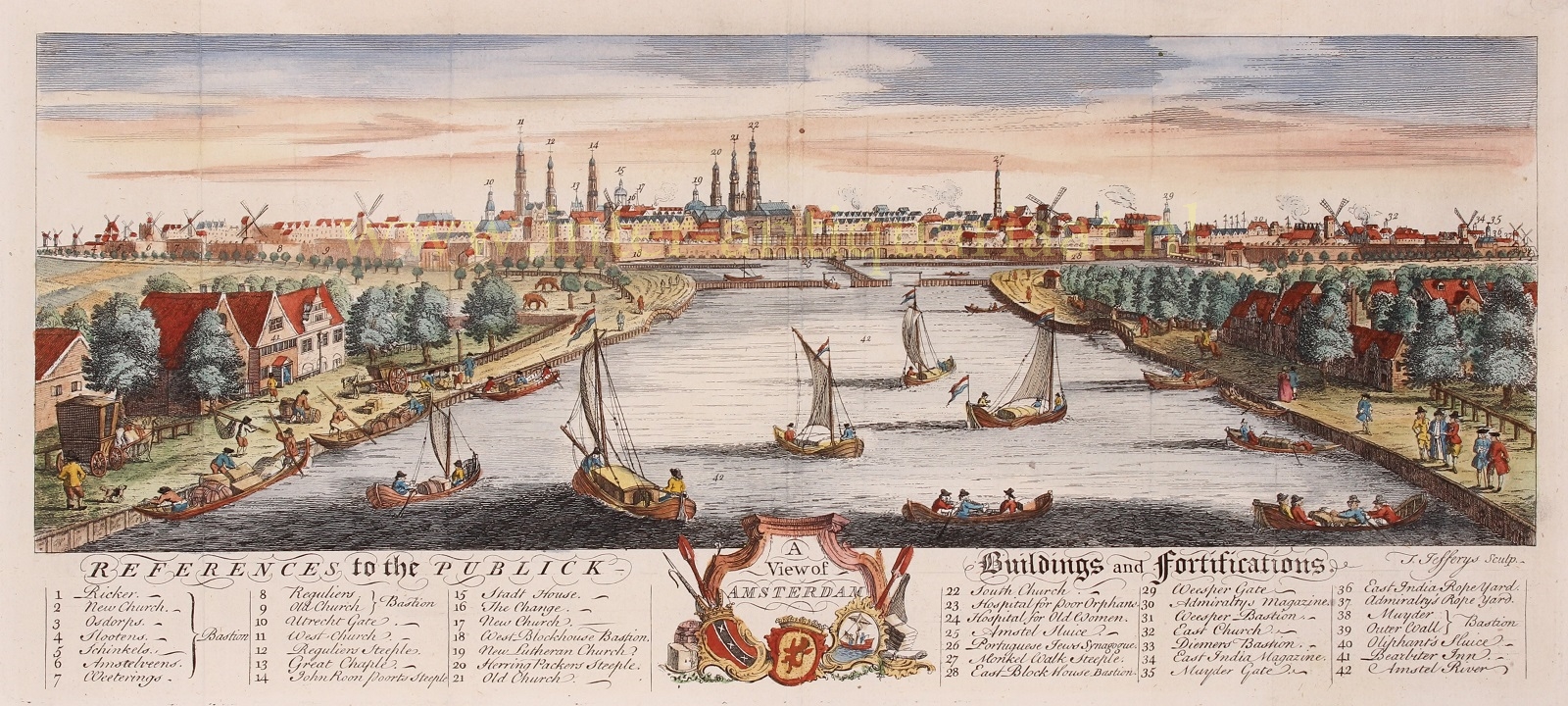
By the mid-eighteenth century, Amsterdam was no longer at the peak of its Golden Age, yet it remained one of Europe’s largest and most dynamic cities. Trade, shipping, crafts, and finance continued to attract newcomers from across the Dutch Republic and beyond. For young migrants, the city offered work, social mobility, and the chance to build a life independent of traditional rural and regional structures.
Migration and Opportunity
The move from Dortmund to Amsterdam was driven by both pull and push factors. Amsterdam promised opportunity, wages, and a future shaped by commerce rather than agriculture or local administration. At the same time, conditions in Germany were often harsh: the long shadow of war, economic stagnation, and limited prospects made remaining at home increasingly difficult. For Barend and Willem Springorum, the journey was an act of courage as well as necessity—an adventure into a wider world, but also a response to circumstances that left little room to thrive where they came from.
A New Branch Takes Root
In Amsterdam, the Springorum name became firmly established. From Barend and Willem onward, the family integrated into urban life, forming the basis of a new and enduring branch. While their origins lay in Westphalia, it was in Amsterdam that this line developed its own identity, extending across generations and eventually spreading beyond the city in the centuries that followed.
The Dutch Springorum Line — Main Branches
From Joan Wilhelm (Willem) Springorum the Dutch line develops in a clear and traceable succession through his son Gerardus (Gerrit) Springorum I and grandson Gerardus Hendricus (Gerrit) Springorum II. In the next generation the family divides into two principal branches: one descending from Gerardus Johannes (Gerrit) Springorum III, and the other from Adrianus Johannes (Ad) Springorum. From these two men the later Amsterdam lines unfold, each producing multiple sons who carried the name into the twentieth century.
- Joan Wilhelm (Willem) Springorum
- Gerardus (Gerrit) Springorum I
- Gerardus Hendricus (Gerrit) Springorum II
- Gerardus Johannes (Gerrit) Springorum III
- Gerardus Cornelis Henricus (Gerard) Springorum
- Johannes Cornelis Petrus (Jan) Springorum
- Adrianus Johannes (Ad) Springorum
- Arnoldus Bernardus Antonius (Arnold) Springorum
- Petrus Gijsbertus (Piet) Springorum
- Johan Franciscus Nicolaas (Jan) Springorum
- Johannes Gerardus Maria (Jan) Springorum
- Arnoldus Bernardus Antonius (Arnold) Springorum
- Gerardus Johannes (Gerrit) Springorum III
- Gerardus Hendricus (Gerrit) Springorum II
- Gerardus (Gerrit) Springorum I
Based on civil records, parish registers, and modern family reconstructions, it appears that most — and quite possibly all — living Springorums in the Netherlands descend from one of these branches. What began with a migration to Amsterdam in the eighteenth century thus evolved into a structured and interconnected Dutch lineage, whose detailed subdivisions are outlined in the sections that follow.
Generation 4
 — one of the first Springorums to settle in Amsterdam. Unlike his brother Barend, whose life was shaped by the sea, Willem built his existence within the city itself, working in the grocery trade and raising a large family. His life reflects the quieter side of migration: not voyages and war, but shopfronts, neighbourhood ties, and the daily effort of making a living in eighteenth-century Amsterdam.](/people/joan_wilhelm_springorum_1744/joan_wilhelm_springorum_1744.jpg)
The baptism record of Barend Springorum provides a firm point of departure for the Amsterdam branch of the family. It identifies Johann Heinrich and Helena Herdinck as the grandparents of Barend and his brother Willem, who both moved to Amsterdam at a young age.
Their move was not merely a matter of curiosity or ambition. Amsterdam offered real opportunities—work, trade, and social mobility—in a rapidly growing city, while conditions in Germany at the time were marked by economic hardship, instability, and limited prospects. For Barend and Willem, the journey to Amsterdam was both an adventure into a wider world and, in part, a response to a situation at home that had become increasingly difficult. With their arrival, a new branch of the Springorum family took shape, no longer rooted in Westphalia but in the expanding urban life of Amsterdam.
Josephus Bernhardus Hendricus (Barend) Springorum (1742 – 1787)
In het begin van de jaren 1780 wendde hij zich tot de kaapvaart en trad hij op als kaapbaas van het schip De Spion tijdens de Vierde Engelse Oorlog. Zijn privéleven werd gekenmerkt door herhaald verlies: zijn kinderen overleden jong of verdwijnen uit de bronnen. Zwaar ziek stelde Barend in december 1786 samen met zijn vrouw Willemina een gezamenlijk testament op; kort daarna, in januari 1787, overleed hij.
Joan Wilhelm (Willem) Springorum (1744 – ?)
Generation 5
With Gerardus (Gerrit) Springorum I, the Dutch line really becomes traceable in a solid way. He was Willem’s oldest son and the only child for whom we can find consistent and structured records in the archives. Willem had eight children in total, four of them boys. One of the boys died at the age of two, and the other two gradually disappear from the records, leaving no clear trace of what became of them.
Gerardus (Gerrit) Springorum I (1783 – 1823)
Generation 6
In the next generation we see something similar. Gerardus Hendricus (Gerrit) Springorum I had six children. Three were daughters. Of the three boys, one died at six months old and the oldest boy died at the age of one and a half. Only the youngest son survived and continued the Springorum name. Again, the family line depended on just one surviving boy.
Gerardus Hendricus (Gerrit) Springorum II (1816 – 1882)
Generation 7 – Two Amsterdam Springorum Lines
 — a man whose life was closely connected to his work. He celebrated an exceptional milestone: a 60-year jubilee at Van Zuylekom, Levert & Co. Such loyalty to one company reflects perseverance, reliability, and a strong sense of responsibility. Through changing times, he remained a steady presence within the firm — a quiet example of dedication across an entire working life. <br> _Source: Algemeen Handelsblad, 4 March 1924._](/people/gerardus_springorum_1845/gerardus_springorum_1845.jpg)
Source: Algemeen Handelsblad, 4 March 1924.
By the mid-19th century the Amsterdam Springorum line crystallizes into two distinct and enduring male-line branches. From this point forward, every documented Dutch Springorum can be traced back to one of two men:
Gerardus Johannes (Gerrit) Springorum III (1845 – 1928)
Adrianus Johannes (Ad) Springorum (1854 – 1916)
These two individuals form the definitive structural split within the Dutch branch of the family. Earlier generations show continuity within Amsterdam, but it is here that the lineage divides into parallel male lines that continue independently into the twentieth century and into living memory.
All later Amsterdam sub-branches descend from either Gerardus Johannes or Adrianus Johannes. Despite extensive civil-registry research, no evidence has emerged of an additional, independent Springorum migration into the Netherlands during the nineteenth century.
Given the rarity of the surname, the documented eighteenth-century migration from Westphalia, and the uninterrupted archival continuity within Amsterdam, the conclusion is compelling: All Springorums currently living in the Netherlands descend from one of these two Generation 7 patriarchs.
Generation 8 – The Four Amsterdam Branches
From the two Generation 7 patriarchs emerge four clearly distinguishable male-line branches. These branches form the structural backbone of the Springorum presence in the Netherlands from the late nineteenth century onward.
Descendants of Gerardus Johannes Springorum III
Gerardus Cornelis Henricus (Gerard) Springorum (1884 – 1962)
Johannes Cornelis Petrus (Jan) Springorum (1892 – ?)
These lines represent the continuation of the older Amsterdam urban branch. Their descendants remained largely rooted in the city and surrounding region, preserving the established Dutch Springorum presence across successive generations.
Descendants of Adrianus Johannes Springorum
Arnoldus Bernardus Antonius (Arnold) Springorum (1887 – 1945)
Johannes Gerardus Maria (Jan) Springorum (1904 – 1965)
From this branch the name moves decisively into the twentieth century and into living memory. A substantial part of the present-day Dutch Springorum population descends from one of these two lines.
Together, these four branches account for all presently traceable Dutch Springorum male lines. No additional independent Dutch-origin branches have been identified.
From here, the narrative shifts from structural division to individual family stories — as Generation 9 and beyond carry these lines into the modern era.
Generation 9
Petrus Gijsbertus (Piet) Springorum (1915 – 1978)
Beyond Amsterdam
This is where the Amsterdam branch comes to an end — not because the Springorum family itself does, but because, after the Second World War, the family gradually began to move away from the city. Some branches had already shifted toward Utrecht in the 1940s and 1950s. My grandfather Petrus Gijsbertus (Piet) Springorum followed a different path: via Castricum — where my father was born — he eventually settled in Nijmegen, where I was born. The line continued once more to Eindhoven, where my son was born. From that point onward, the family story no longer belongs to a single city, but unfolds across multiple places, extending beyond Amsterdam into a broader Dutch landscape.
Generation 10
Theodorus Petrus Alphonsus Franciscus (Dick) Springorum (1941 – 2020)
Generation 11
Rudolf Theodoor (Rudolf) Springorum (1969 – ?)
Generation 12
Early Springorum Mentions in Amsterdam
While the Amsterdam branch described here represents a clearly established and continuous family line, it does not account for every appearance of the Springorum name in the city. Before and alongside this lasting settlement, the name also occurs sporadically in Amsterdam records, often without evidence of permanent residence or descendants. These earlier and isolated references form a separate category of sources. They are documented in the section on early mentions, where the focus lies on recording historical occurrences without assuming familial continuity.