Springorum Origins in Bochum (1400–1600)
Bochum in the 15th and 16th Century
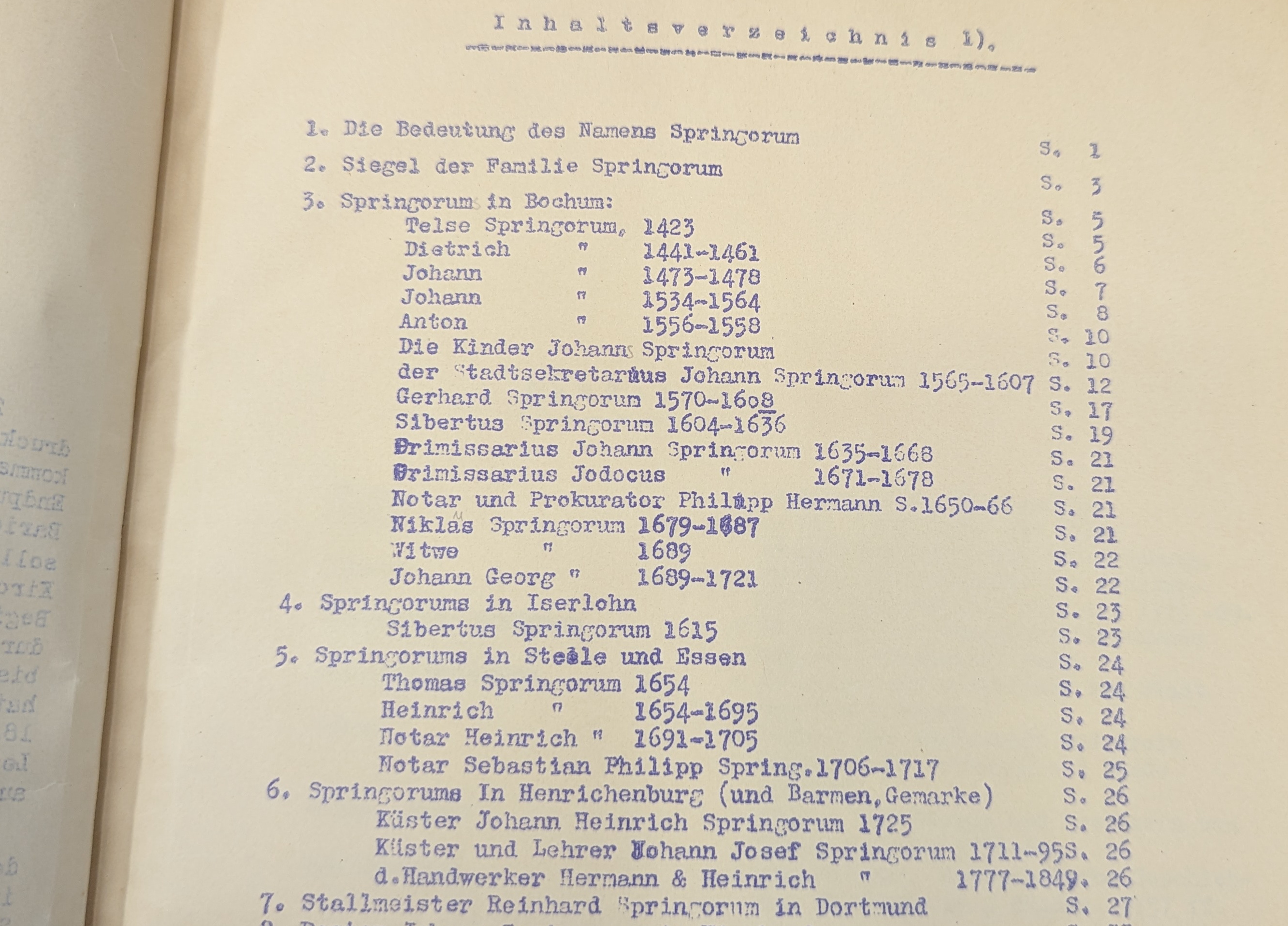
This page examines the earliest known occurrences of the Springorum name in Bochum and the surrounding region of Westphalia between 1400 and 1600. Drawing on early civic records, legal documents, and later testamentary evidence, it brings together the first documented name bearers who appear in and around the town long before the emergence of a provable line of descent.
Long before Reinhard Springorum enters the record, the name already appears repeatedly in fifteenth- and sixteenth-century sources, always concentrated in and around Bochum. At this stage, the focus lies not on reconstructing a single continuous pedigree, but on identifying recurring individuals, family clusters, and the historical setting in which the name took shape. These early references provide essential context for understanding how a stable and traceable Springorum lineage eventually emerged in the late sixteenth century.
Brief Historical Overview: Bochum 1400-1600
Around 1400, Bochum was a modest town in the County of Mark, set along the Westphalian Hellweg—the main east–west artery through Westphalia. It functioned more as a local court seat (Gogericht) and market town than as a major trading hub. The first mayors appear in the record in 1407, and in 1438 a knight endowed the Rodden-Gut in Gerthe to fund a charitable guesthouse (Gasthaus) and hospital for the poor—evidence of emerging civic institutions and organized social care.
The Bochum Town Fire of 1517
The defining catastrophe was the great city fire of Mark’s Day, 25 April 1517. Starting in the house of a townsman named Johann Schrivers genn. Springorum, flames raced through dense timbered streets and thatched roofs, destroying virtually the whole town, including the old parish church. Rebuilding took years: the church (today’s Propsteikirche St. Peter und Paul) received its net vaulting in 1536 and a completed tower by 1547; municipal reconstruction stretched across the decade. During the fire, Bochum’s main parish church was destroyed by fire also. To finance the construction of a new church, a tax was levied. From the so-called “Kirchensteuer” list of 1525, we know that the town of Bochum at that time consisted of roughly one hundred houses and 157 inhabitants. Two hundred years later, in 1722, the town had grown to 350 houses, 135 of which were still roofed with thatch.
Epidemics
Epidemics repeatedly stalled recovery. In addition to an outbreak of the so-called “English sweat” in 1529, Bochum was hit by several waves of plague during the sixteenth century, recorded in 1542, 1544, 1583, and 1589. The plague of 1544 was so severe that inhabitants were said to have fled into the surrounding woods. The impact of these epidemics can also be seen on an individual level: Agnes Springorum, who died in 1568, fell victim to the plague of that year. Together with another major town fire in 1581, these repeated blows kept both population numbers and prosperity fragile.
Politically, Bochum lay within the County of Mark, which from 1521 formed part of the United Duchies of Jülich-Cleves-Berg. This broader political framework shaped administration, taxation, and confessional policy in the region. Within that setting—and aided by Bochum’s position along the Hellweg route through nearby Wattenscheid and Bochum itself—the town slowly and cautiously rebuilt toward the end of the sixteenth century.
Politics, War and Religion
In the 15th and 16th centuries, Bochum was part of the County of Mark and had to follow the politics of its rulers. The town itself saw little fighting, but people still felt the effects of wars and rising taxes. After 1520, the Reformation brought new Protestant ideas that spread through the region and clashed with the old Catholic traditions. Parish life and church appointments often became a point of conflict. During the Schmalkaldic War (1546–1547), the struggle between Protestants and Catholics touched Bochum as well, adding to the uncertainty already caused by fire, plague, and poverty.
The Springorum Origins: A Tentative Pedigree
Generation -7 (Earliest Known Ancestors)
The Springorum name first appears in early-15th-century Bochum. Two figures belong to this generation: Telse Springorum, recorded in 1423, and Dietrich Springorum, documented in 1441 with his wife Karden and their children Baten and Johann (der Ältere). Although a familial connection between Telse and Dietrich is possible, it is not explicitly attested, and they are therefore treated as parallel members of the same generation.
Telse Springorum (c. 1370 – ?)
Dietrich Springorum (c. 1395 – ?)
Een bijzonder belangrijke akte uit 1441 vermeldt de verkoop van een jaarlijkse geldrente uit zijn huis en hofstede achter het Bungener-huis en noemt expliciet zijn vrouw en zonen. Daarmee levert zij zeldzaam vroeg bewijs voor de samenstelling van de familie Springorum en markeert zij het beginpunt van de gedocumenteerde familielijn.
Latere bronnen tonen Dietrich als eigenaar van onroerend goed, geldschieter, beheerder en juridische getuige — rollen die wijzen op financiële zekerheid, geletterdheid en een gerespecteerde positie binnen de Bochumse gemeenschap. Samen met zijn vrouw Karden staat hij aan het begin van de gedocumenteerde geschiedenis van de familie Springorum.
Generation -6
Johann Springorum (der Ältere), proven son of Dietrich and Karden, is securely documented and represents the continuation of the Bochum Springorum household into the later 15th century.
Johann Springorum der Ältere (c. 1420 – ?)
Zijn invloed reikte tot in de volgende generatie via zijn dochter Nese (Agnes) Springorum, die trouwde met Johann Schriver, Richter zu Essen. Door dit huwelijk werd de naam Springorum doorgegeven aan Johann Schriver, die vervolgens wordt vermeld als Johann Schriver genannt Springorum. Zo werd de familienaam via de vrouwelijke lijn voortgezet in latere generaties.
Generation -5
This generation consists of Johann Schriver and Nese Springorum, who are securely identified as the parents of the next generation. Nese Springorum is proven to be a daughter of Johann Springorum der Ältere, anchoring this family group firmly within the established Springorum lineage. Their placement advances the later Schriver genannt Springorum line by one generation.
Nese Springorum (c. 1445 – ?)
Het feit dat hun zoon de familienaam van moederszijde aannam, wijst erop dat Nese behoorde tot een sociaal vooraanstaande en stevig gevestigde familie, waarvan de naam voldoende status en erkenning bezat om over generaties heen te worden behouden.
Generation -4
 (* c. 1475 – † ?) played a central role in the civic life of his city.](/people/johann_schriver_genannt_springorum_c1475/johann_schriver_genannt_springorum_c1475.jpg)
Johann Schriver genannt Springorum, proven son of Johann Schriver and Nese Springorum, marks the point at which Springorum functions as a stable hereditary identifier in Bochum records. He stands at the transition between late-medieval naming practice and early-modern family continuity.
Johann Schriver genannt Springorum (c. 1475 – ?)
Generation -3
The parents of the mid-sixteenth-century sibling group were Johann Springorum and Margarete von den Hembecke, as recorded in the will of their daughter Agnes. Although little is known about their individual lives, their place within the family line is firmly established through the clear and consistent documentation of their children.
Johann Springorum I (c. 1505 – c. 1560)
Dit document, opgesteld toen Gerrit en Agnes zich voorbereidden op een reis, bevestigt niet alleen Johanns rol als hun vader, maar laat ook zien hoe zijn kinderen het beheer en de toekomstige vererving van hun bezit in Bochum regelden.
Generation -2
This generation consists of the siblings Johann, Agnes, Gerrit, Sibert, Anna, and Dietrich Springorum. Johann is particularly well documented, appearing repeatedly as a witness in his role as Gerichtsschreiber. Agnes and Gerrit are likewise well attested: on 14 January 1568, they concluded a mutual inheritance contract before departing on a journey abroad. Later that same year, during an outbreak of plague, Agnes drew up her will in Cologne and founded a charitable endowment in Bochum to provide dowries for impoverished brides. Taken together, the surviving records of this sibling group point to considerable wealth as well as a strong position within civic society.
Johann Springorum II (c. 1540 – c. 1612)
 (1542-1568) moved within a world shaped by property, law, and strategic marriage. Connected to judges and city officials—including the Schriver family—she reflects a lineage whose status was built not on nobility, but on wealth, legal standing, and civic influence. Her ability, at a young age, to dispose of a substantial fortune underscores the economic power and autonomy that women of this milieu could hold.](/people/agnes_springorum_1542/agnes_springorum_1542.jpg)
Agnes Springorum (1542 – 1568)
Generation -1
With Agnes Springorum born in 1542 and Reinhard Springorum in 1593, it is reasonable to assume that at least one intervening generation separates them.
? Sibertus Springorum ?
Generation 0
Once we arrive at Reinhard Springorum, the picture changes. From that point onward, the line of descent is clear: subsequent generations are consistently documented, and their descent from Reinhard can be traced and proven without gaps.
Reinhard (Reinhard) Springorum (1593 – 1666)
From Early Name Bearers to a Documented Family Line
These early Bochum references provide the background against which a clearly traceable family line begins to emerge in the seventeenth century, when the Springorum name becomes firmly established in Dortmund and the surrounding Ruhr area.